
Ship Captains and Officers
Ship captains and officers command or supervise operations of ships and water vessels, such as tugboats and ferryboats.
Opening this tab’s Trail…
Fictional preview only. Closing this tab or clearing browser data can remove this work; no account or cloud sync.
What the work involves
O*NET task statements for this occupation.
- Direct courses and speeds of ships, based on specialized knowledge of local winds, weather, water depths, tides, currents, and hazards.
- Prevent ships under navigational control from engaging in unsafe operations.
- Serve as a vessel's docking master upon arrival at a port or at a berth.
See 21 more tasks
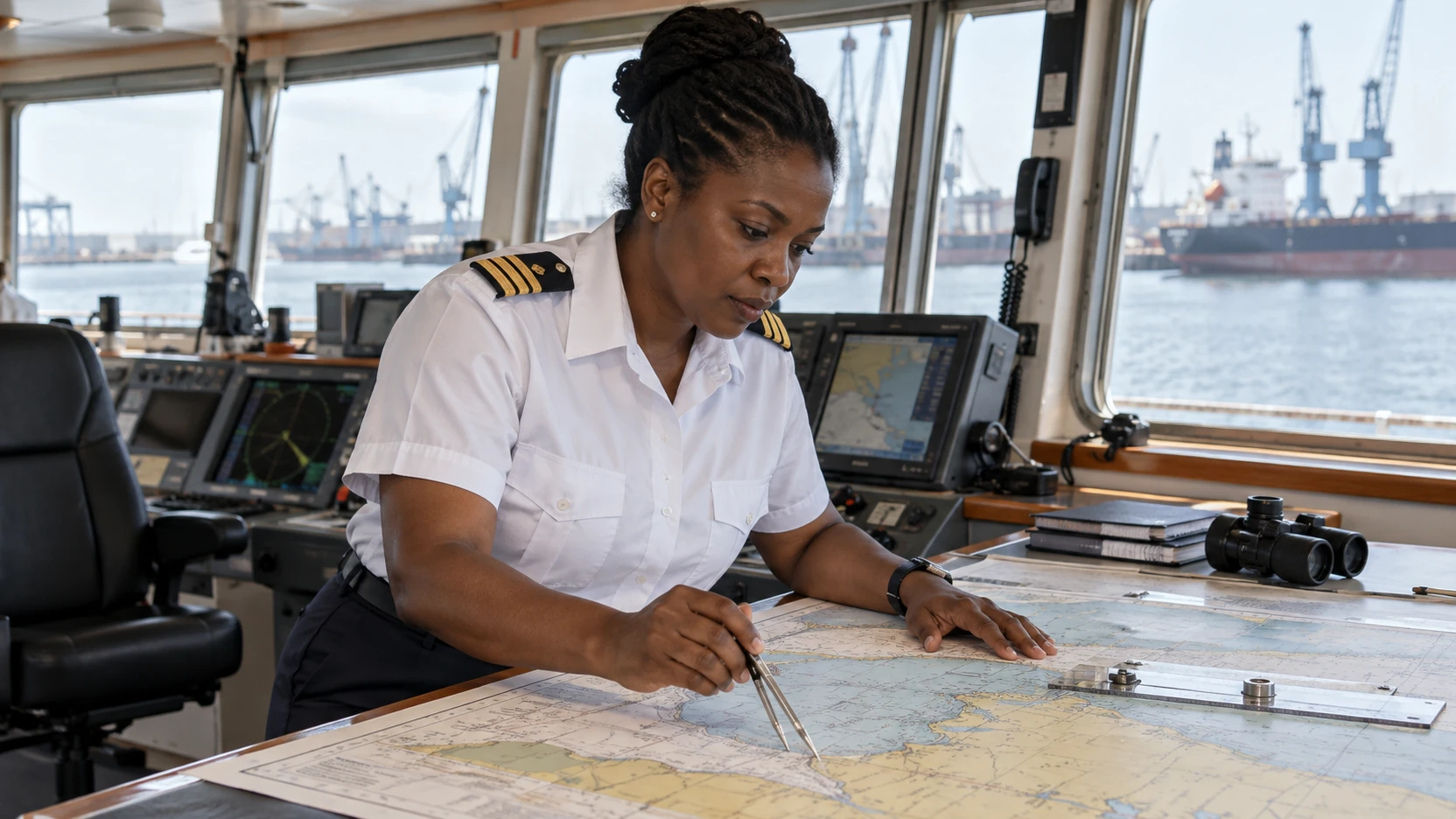
- Consult maps, charts, weather reports, or navigation equipment to determine and direct ship movements.
- Steer and operate vessels, using radios, depth finders, radars, lights, buoys, or lighthouses.
- Operate ship-to-shore radios to exchange information needed for ship operations.
- Dock or undock vessels, sometimes maneuvering through narrow spaces, such as locks.
- Stand watches on vessels during specified periods while vessels are under way.
- Inspect vessels to ensure efficient and safe operation of vessels and equipment and conformance to regulations.
- Read gauges to verify sufficient levels of hydraulic fluid, air pressure, or oxygen.
- Report to appropriate authorities any violations of federal or state pilotage laws.
- Provide assistance in maritime rescue operations.
- Signal passing vessels, using whistles, flashing lights, flags, or radios.
- Measure depths of water, using depth-measuring equipment.
- Signal crew members or deckhands to rig tow lines, open or close gates or ramps, or pull guard chains across entries.
- Maintain boats or equipment on board, such as engines, winches, navigational systems, fire extinguishers, or life preservers.
- Maintain records of daily activities, personnel reports, ship positions and movements, ports of call, weather and sea conditions, pollution control efforts, or cargo or passenger status.
- Advise ships' masters on harbor rules and customs procedures.
- Observe loading or unloading of cargo or equipment to ensure that handling and storage are performed according to specifications.
- Calculate sightings of land, using electronic sounding devices and following contour lines on charts.
- Learn to operate new technology systems and procedures through instruction, simulators, or models.
- Direct or coordinate crew members or workers performing activities such as loading or unloading cargo, steering vessels, operating engines, or operating, maintaining, or repairing ship equipment.
- Arrange for ships to be fueled, restocked with supplies, or repaired.
- Supervise crews in cleaning or maintaining decks, superstructures, or bridges.
A question about this career
Which part of this work would you like to see in person? Save this career to your Trail and keep the question beside it.
Open my TrailSkills, knowledge and working conditions
Skills used
- Speaking
- Monitoring
- Active Listening
- Critical Thinking
- Operation and Control
- Operations Monitoring
- Judgment and Decision Making
- Coordination
Knowledge that helps
- Transportation
- Public Safety and Security
- Mechanical
- Law and Government
- English Language
- Geography
- People contact
- Constant contact with others · 69% selected this answer
- Time sitting
- Less than half the time · 42% selected this answer
- Outside in the weather
- Every day · 62% selected this answer
- Teamwork
- Extremely important · 62% selected this answer
Education and training
- Typical entry education
- Postsecondary nondegree award
- BLS figure for this job
- Overall preparation
- Job Zone 3
- Job Zone Three: Medium Preparation Needed
Training and experience
Most occupations in this zone require training in vocational schools, related on-the-job experience, or an associate's degree.
None
Less than 5 years
Pay and employment
Median annual pay
$92,460
8 in 10 earn $47,420–$170,640 · May 2025 · BLS figure for this job
National job outlook
2025–35 · BLS figure for this job
Compare states on the map
Where people work
May 2025 · BLS state estimates
Hover to preview; select a state to keep its details. Zoom and scroll for a closer look, or use the state menu. On the map, arrow keys move through states alphabetically. Enter or Space selects a state.
These are jobs people already hold, not vacancies. Self-employed workers are not included.
About these figures and the map
Shading compares states with published estimates for Captains, Mates, and Pilots of Water Vessels. Concentration means jobs in this occupation per 1,000 employed people in a state. Total jobs means estimated employment, not openings. The figures exclude self-employed workers. Striped gray states have no published estimate for the selected measure; that does not mean no one works there.
Boundaries: US Atlas / US Census. Larger states occupy more map area; their size does not indicate more jobs.
Occupation interest pattern
Interest pattern
What this work leans on
Career ratings are out of 7. Your completed quiz totals are out of 50. These are different scales; the overall pattern matters, not equal bar lengths or ability.
- Building (Realistic)5.6Career rating 5.6 of 7. No personal quiz comparison.
- Organizing (Conventional)4.6Career rating 4.6 of 7. No personal quiz comparison.
- Leading (Enterprising)4.2Career rating 4.2 of 7. No personal quiz comparison.
- Investigating (Investigative)2.6Career rating 2.6 of 7. No personal quiz comparison.
- Helping (Social)1.9Career rating 1.9 of 7. No personal quiz comparison.
- Creating (Artistic)1.0Career rating 1.0 of 7. No personal quiz comparison.
More specific themes
- Nature/Outdoors
- Management/Administration
- Transportation/Machine Operation
Related careers to explore
- Ship Deck and Engine-Room Crew
- Motorboat Operators
- Ship Engineers
- Airline Pilots
- Commercial Pilots
- Transportation Inspectors
- Aircraft Cargo Supervisors
- Train Drivers (Locomotive Engineers)
- Dredge Operators
- Fishing and Hunting Workers
- Riggers
- Railroad Brake and Switch Operators
- Marine Engineers and Naval Architects
- Train Conductors and Yardmasters
- Commercial Divers
- Hoist and Winch Operators
- Airfield Operations Specialists
- Rail Yard Locomotive Operators
Take a closer look
Investigate one question.
Choose something you still want to understand. Start with the information on this page, or look for a person describing their work.
- What does someone in this job spend time doing?
- What is challenging about the work, and how do they handle it?
- What changes when this job is done in a different workplace?
Find and check an example
This link searches Google in a new tab. Results have not been selected or checked by Kairos. Use your school’s browsing guidance; searching is optional.
The search uses this career’s public title, never your answers or notes.
- Check who made it, when it was made, and which job and workplace it describes.
- Look for a specific example that helps answer your question. A personal story describes one experience, not every job.
- Compare it with this page or a second source. Keep track of what is still uncertain.
For a closer comparison, explain why two people in the same occupation might describe different days.
If you want to return to this career, use “Save to my trail” above. In Trail, write a reason it interests you or a question to follow up.
Open my trail