
Railroad Brake and Switch Operators
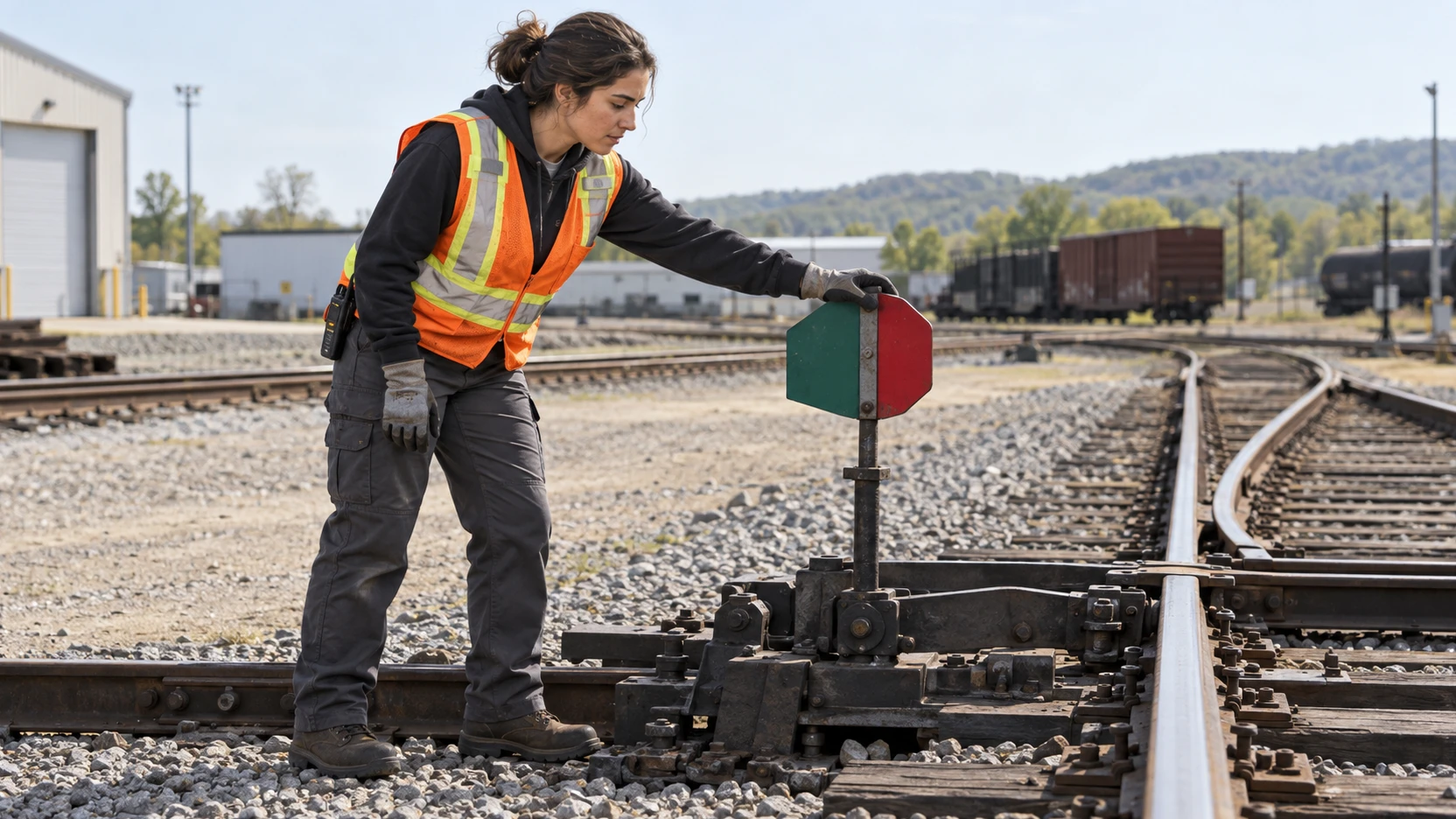
Railroad brake and switch operators operate or monitor railroad track switches or locomotive instruments.
Opening this tab’s Trail…
Fictional preview only. Closing this tab or clearing browser data can remove this work; no account or cloud sync.
What the work involves
O*NET task statements for this occupation.
- Signal locomotive engineers to start or stop trains when coupling or uncoupling cars, using hand signals, lanterns, or radio communication.
- Observe train signals along routes and verify their meanings for engineers.
- Inspect couplings, air hoses, journal boxes, and handbrakes to ensure that they are securely fastened and functioning properly.
See 12 more tasks
- Raise levers to couple and uncouple cars for makeup and breakup of trains.
- Pull or push track switches to reroute cars.
- Observe signals from other crew members so that work activities can be coordinated.
- Conduct brake tests to determine the condition of brakes on trains.
- Monitor trains as they go around curves to detect dragging equipment and smoking journal boxes.
- Receive oral or written instructions from yardmasters or yard conductors indicating track assignments and cars to be switched.
- Inspect tracks, cars, and engines for defects and to determine service needs, sending engines and cars for repairs as necessary.
- Observe tracks from left sides of locomotives to detect obstructions on tracks.
- Signal other workers to set brakes and to throw track switches when switching cars from trains to way stations.
- Connect air hoses to cars, using wrenches.
- Record numbers of cars available, numbers of cars sent to repair stations, and types of service needed.
- Make minor repairs to couplings, air hoses, and journal boxes, using hand tools.
A question about this career
Which part of this work would you like to see in person? Save this career to your Trail and keep the question beside it.
Open my TrailSkills, knowledge and working conditions
Skills used
- Monitoring
- Active Listening
- Speaking
- Critical Thinking
- Operations Monitoring
- Coordination
- Operation and Control
- Judgment and Decision Making
Knowledge that helps
- Transportation
- Public Safety and Security
- Administration and Management
- English Language
- Customer and Personal Service
- Education and Training
- People contact
- Contact with others most of the time · 51% selected this answer
- Outside in the weather
- Every day · 84% selected this answer
- In-person discussions
- Every day · 89% selected this answer
- Decision freedom
- Some freedom · 40% selected this answer
Education and training
- Typical entry education
- High school diploma or equivalent
- BLS figure for this job
- Overall preparation
- Job Zone 1–2
- Job Zone 1-2: Very Little to Some Preparation Needed
Training and experience
Usually requires a high school diploma or GED, though some occupations may not.
Moderate-term on-the-job training
Pay and employment
Median annual pay
$68,840
8 in 10 earn $45,660–$86,590 · May 2025 · BLS figure for this job
National job outlook
2025–35 · BLS figure for this job
Compare states on the map
Where people work
May 2025 · BLS state estimates
Hover to preview; select a state to keep its details. Zoom and scroll for a closer look, or use the state menu. On the map, arrow keys move through states alphabetically. Enter or Space selects a state.
These are jobs people already hold, not vacancies. Self-employed workers are not included.
About these figures and the map
Shading compares states with published estimates for Railroad Brake, Signal, and Switch Operators and Locomotive Firers. Concentration means jobs in this occupation per 1,000 employed people in a state. Total jobs means estimated employment, not openings. The figures exclude self-employed workers. Striped gray states have no published estimate for the selected measure; that does not mean no one works there.
Boundaries: US Atlas / US Census. Larger states occupy more map area; their size does not indicate more jobs.
Occupation interest pattern
Interest pattern
What this work leans on
Career ratings are out of 7. Your completed quiz totals are out of 50. These are different scales; the overall pattern matters, not equal bar lengths or ability.
- Building (Realistic)7.0Career rating 7.0 of 7. No personal quiz comparison.
- Organizing (Conventional)4.3Career rating 4.3 of 7. No personal quiz comparison.
- Investigating (Investigative)2.1Career rating 2.1 of 7. No personal quiz comparison.
- Leading (Enterprising)1.4Career rating 1.4 of 7. No personal quiz comparison.
- Helping (Social)1.2Career rating 1.2 of 7. No personal quiz comparison.
- Creating (Artistic)1.0Career rating 1.0 of 7. No personal quiz comparison.
More specific themes
- Mechanics/Electronics
- Physical/Manual Labor
- Transportation/Machine Operation
Related careers to explore
- Train Drivers (Locomotive Engineers)
- Rail Yard Locomotive Operators
- Train Conductors and Yardmasters
- Diesel and Heavy Vehicle Mechanics
- Hoist and Winch Operators
- Rail Signal and Track Switch Technicians
- Rail Car Repairers
- Subway and Streetcar Operators
- Industrial Forklift and Tractor Operators
- Construction Equipment Operators
- Heavy Truck and Tractor-Trailer Drivers
- Underground Mining Loader Operators
- Crane and Tower Operators
- Conveyor Operators
- Electrical Power Line Technicians
- Ship Deck and Engine-Room Crew
- Heavy Equipment Mechanics
- Ship Engineers
Take a closer look
Investigate one question.
Choose something you still want to understand. Start with the information on this page, or look for a person describing their work.
- What does someone in this job spend time doing?
- What is challenging about the work, and how do they handle it?
- What changes when this job is done in a different workplace?
Find and check an example
This link searches Google in a new tab. Results have not been selected or checked by Kairos. Use your school’s browsing guidance; searching is optional.
The search uses this career’s public title, never your answers or notes.
- Check who made it, when it was made, and which job and workplace it describes.
- Look for a specific example that helps answer your question. A personal story describes one experience, not every job.
- Compare it with this page or a second source. Keep track of what is still uncertain.
For a closer comparison, explain why two people in the same occupation might describe different days.
If you want to return to this career, use “Save to my trail” above. In Trail, write a reason it interests you or a question to follow up.
Open my trail