
Commercial Divers
Commercial divers work below surface of water, using surface-supplied air or scuba equipment to inspect, repair, remove, or install equipment and structures.
Opening this tab’s Trail…
Fictional preview only. Closing this tab or clearing browser data can remove this work; no account or cloud sync.
What the work involves
O*NET task statements for this occupation.
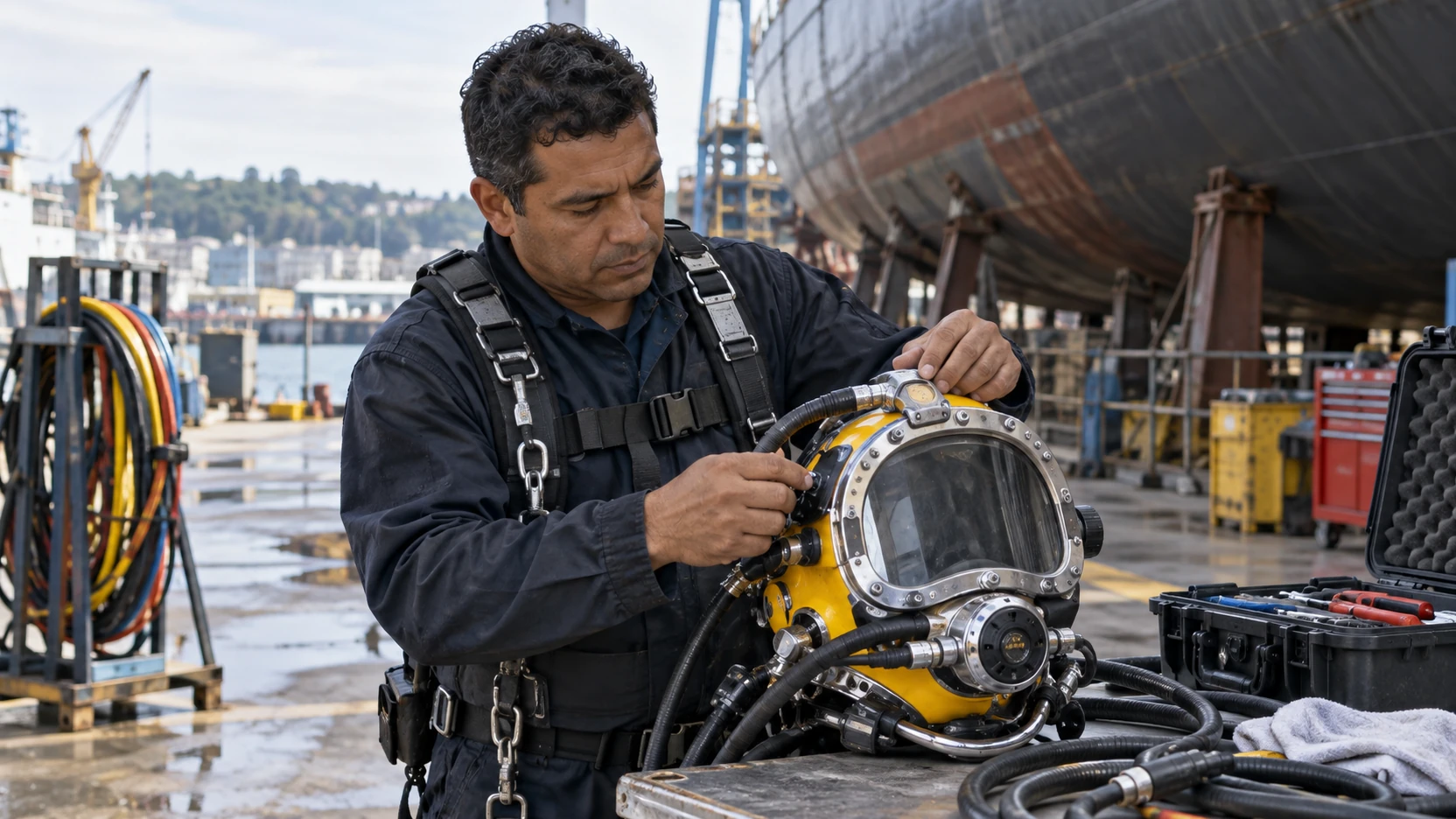
- Check and maintain diving equipment, such as helmets, masks, air tanks, harnesses, or gauges.
- Take appropriate safety precautions, such as monitoring dive lengths and depths and registering with authorities before diving expeditions begin.
- Communicate with workers on the surface while underwater, using signal lines or telephones.
See 17 more tasks
- Descend into water with the aid of diver helpers, using scuba gear or diving suits.
- Inspect and test docks, ships, buoyage systems, plant intakes or outflows, or underwater pipelines, cables, or sewers, using closed circuit television, still photography, and testing equipment.
- Obtain information about diving tasks and environmental conditions.
- Inspect the condition of underwater steel or wood structures.
- Operate underwater video, sonar, recording, or related equipment to investigate underwater structures or marine life.
- Repair ships, bridge foundations, or other structures below the water line, using caulk, bolts, and hand tools.
- Cut and weld steel, using underwater welding equipment, jigs, and supports.
- Carry out non-destructive testing, such as tests for cracks on the legs of oil rigs at sea.
- Take test samples or photographs to assess the condition of vessels or structures.
- Supervise or train other divers, including hobby divers.
- Perform activities related to underwater search and rescue, salvage, recovery, or cleanup operations.
- Recover objects by placing rigging around sunken objects, hooking rigging to crane lines, and operating winches, derricks, or cranes to raise objects.
- Install, inspect, clean, or repair piping or valves.
- Set or guide placement of pilings or sandbags to provide support for structures, such as docks, bridges, cofferdams, or platforms.
- Install pilings or footings for piers or bridges.
- Salvage wrecked ships or their cargo, using pneumatic power velocity and hydraulic tools and explosive charges, when necessary.
- Remove obstructions from strainers or marine railway or launching ways, using pneumatic or power hand tools.
A question about this career
Which part of this work would you like to see in person? Save this career to your Trail and keep the question beside it.
Open my TrailSkills, knowledge and working conditions
Skills used
- Active Listening
- Critical Thinking
- Speaking
- Reading Comprehension
- Operations Monitoring
- Quality Control Analysis
- Coordination
- Complex Problem Solving
Knowledge that helps
- Mechanical
- Building and Construction
- Public Safety and Security
- Physics
- Design
- Customer and Personal Service
- People contact
- Constant contact with others · 87% selected this answer
- Time sitting
- Less than half the time · 50% selected this answer
- Outside in the weather
- Every day · 87% selected this answer
- Teamwork
- Extremely important · 73% selected this answer
Education and training
- Typical entry education
- Postsecondary nondegree award
- BLS figure for this job
- Overall preparation
- Job Zone 3
- Job Zone Three: Medium Preparation Needed
Training and experience
Most occupations in this zone require training in vocational schools, related on-the-job experience, or an associate's degree.
Moderate-term on-the-job training
Pay and employment
Median annual pay
$72,990
8 in 10 earn $43,330–$157,790 · May 2025 · BLS figure for this job
National job outlook
2025–35 · BLS figure for this job
Compare states on the map
Where people work
May 2025 · BLS state estimates
Hover to preview; select a state to keep its details. Zoom and scroll for a closer look, or use the state menu. On the map, arrow keys move through states alphabetically. Enter or Space selects a state.
These are jobs people already hold, not vacancies. Self-employed workers are not included.
About these figures and the map
Shading compares states with published estimates for Commercial Divers. Concentration means jobs in this occupation per 1,000 employed people in a state. Total jobs means estimated employment, not openings. The figures exclude self-employed workers. Striped gray states have no published estimate for the selected measure; that does not mean no one works there.
Boundaries: US Atlas / US Census. Larger states occupy more map area; their size does not indicate more jobs.
Occupation interest pattern
Interest pattern
What this work leans on
Career ratings are out of 7. Your completed quiz totals are out of 50. These are different scales; the overall pattern matters, not equal bar lengths or ability.
- Building (Realistic)7.0Career rating 7.0 of 7. No personal quiz comparison.
- Investigating (Investigative)3.6Career rating 3.6 of 7. No personal quiz comparison.
- Organizing (Conventional)3.1Career rating 3.1 of 7. No personal quiz comparison.
- Leading (Enterprising)1.7Career rating 1.7 of 7. No personal quiz comparison.
- Creating (Artistic)1.4Career rating 1.4 of 7. No personal quiz comparison.
- Helping (Social)1.1Career rating 1.1 of 7. No personal quiz comparison.
More specific themes
- Engineering
- Mechanics/Electronics
- Physical/Manual Labor
Related careers to explore
- Riggers
- Plumbers, Pipefitters and Steamfitters
- Ship Engineers
- Ship Deck and Engine-Room Crew
- Boilermakers
- Earth Drillers (Non-Oil and Gas)
- Oil and Gas Drill Operators
- Dredge Operators
- Hoist and Winch Operators
- Pipelayers
- Marine Engineers and Naval Architects
- Welders and Metal Joining Specialists
- Surface Mining Excavator Operators
- Septic and Sewer Service Technicians
- Construction Laborers
- Oil and Gas Field Laborers
- Construction Equipment Operators
- Heavy Equipment Mechanics
Take a closer look
Investigate one question.
Choose something you still want to understand. Start with the information on this page, or look for a person describing their work.
- What does someone in this job spend time doing?
- What is challenging about the work, and how do they handle it?
- What changes when this job is done in a different workplace?
Find and check an example
This link searches Google in a new tab. Results have not been selected or checked by Kairos. Use your school’s browsing guidance; searching is optional.
The search uses this career’s public title, never your answers or notes.
- Check who made it, when it was made, and which job and workplace it describes.
- Look for a specific example that helps answer your question. A personal story describes one experience, not every job.
- Compare it with this page or a second source. Keep track of what is still uncertain.
For a closer comparison, explain why two people in the same occupation might describe different days.
If you want to return to this career, use “Save to my trail” above. In Trail, write a reason it interests you or a question to follow up.
Open my trail