
Automatic and Mechanical Door Technicians
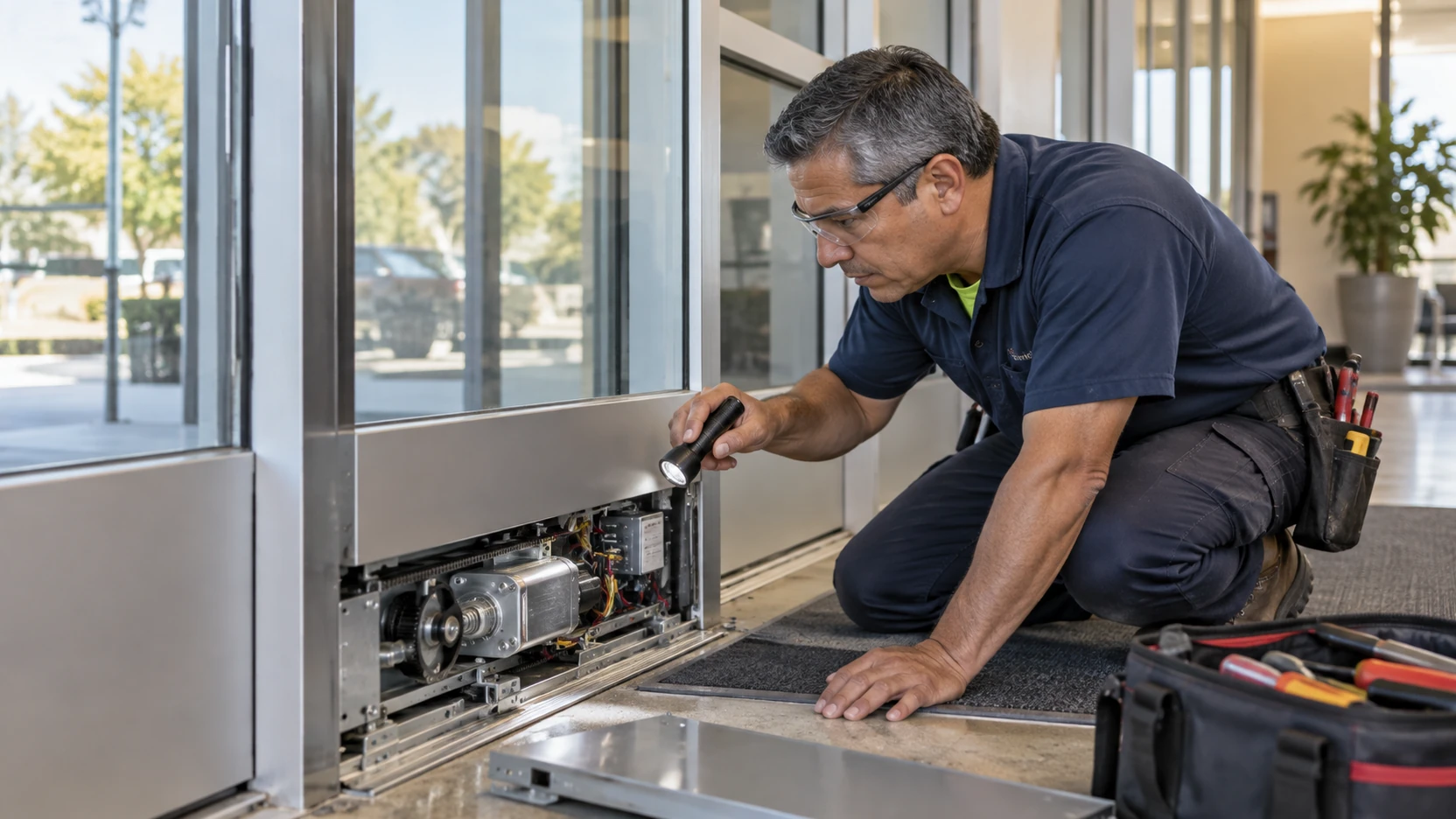
Automatic and mechanical door technicians install, service, or repair automatic door mechanisms and hydraulic doors.
Opening this tab’s Trail…
Fictional preview only. Closing this tab or clearing browser data can remove this work; no account or cloud sync.
What the work involves
O*NET task statements for this occupation.
- Wind large springs with upward motion of arm.
- Complete required paperwork, such as work orders, according to services performed or required.
- Repair or replace worn or broken door parts, using hand tools.
See 16 more tasks
- Fasten angle iron back-hangers to ceilings and tracks, using fasteners or welding equipment.
- Order replacement springs, sections, or slats.
- Carry springs to tops of doors, using ladders or scaffolding, and attach springs to tracks to install spring systems.
- Install door frames, rails, steel rolling curtains, electronic-eye mechanisms, or electric door openers and closers, using power tools, hand tools, and electronic test equipment.
- Adjust doors to open or close with the correct amount of effort, or make simple adjustments to electric openers.
- Set doors into place or stack hardware sections into openings after rail or track installation.
- Assemble and fasten tracks to structures or bucks, using impact wrenches or welding equipment.
- Inspect job sites, assessing headroom, side room, or other conditions to determine appropriateness of door for a given location.
- Collect payment upon job completion.
- Prepare doors for hardware installation, such as drilling holes to install locks.
- Cut door stops or angle irons to fit openings.
- Remove or disassemble defective automatic mechanical door closers, using hand tools.
- Run low voltage wiring on ceiling surfaces, using insulated staples.
- Operate lifts, winches, or chain falls to move heavy curtain doors.
- Install dock seals, bumpers, or shelters.
- Study blueprints and schematic diagrams to determine appropriate methods of installing or repairing automated door openers.
A question about this career
Which part of this work would you like to see in person? Save this career to your Trail and keep the question beside it.
Open my TrailSkills, knowledge and working conditions
Skills used
- Critical Thinking
- Active Listening
- Reading Comprehension
- Speaking
- Installation
- Repairing
- Quality Control Analysis
- Complex Problem Solving
Knowledge that helps
- Administration and Management
- Customer and Personal Service
- Building and Construction
- Mechanical
- English Language
- Mathematics
- Time sitting
- Less than half the time · 69% selected this answer
- Outside in the weather
- Every day · 62% selected this answer
- Teamwork
- Important · 31% selected this answer
- Decision freedom
- A lot of freedom · 59% selected this answer
Education and training
- Typical entry education
- High school diploma or equivalent
- BLS figure for this job
- Overall preparation
- Job Zone 1–2
- Job Zone 1-2: Very Little to Some Preparation Needed
Training and experience
Usually requires a high school diploma or GED, though some occupations may not.
Moderate-term on-the-job training
Pay and employment
Median annual pay
$55,720
8 in 10 earn $38,490–$78,260 · May 2025 · BLS figure for this job
National job outlook
2025–35 · BLS figure for this job
Compare states on the map
Where people work
May 2025 · BLS state estimates
Hover to preview; select a state to keep its details. Zoom and scroll for a closer look, or use the state menu. On the map, arrow keys move through states alphabetically. Enter or Space selects a state.
These are jobs people already hold, not vacancies. Self-employed workers are not included.
About these figures and the map
Shading compares states with published estimates for Mechanical Door Repairers. Concentration means jobs in this occupation per 1,000 employed people in a state. Total jobs means estimated employment, not openings. The figures exclude self-employed workers. Striped gray states have no published estimate for the selected measure; that does not mean no one works there.
Boundaries: US Atlas / US Census. Larger states occupy more map area; their size does not indicate more jobs.
Occupation interest pattern
Interest pattern
What this work leans on
Career ratings are out of 7. Your completed quiz totals are out of 50. These are different scales; the overall pattern matters, not equal bar lengths or ability.
- Building (Realistic)6.9Career rating 6.9 of 7. No personal quiz comparison.
- Organizing (Conventional)4.0Career rating 4.0 of 7. No personal quiz comparison.
- Investigating (Investigative)1.8Career rating 1.8 of 7. No personal quiz comparison.
- Helping (Social)1.5Career rating 1.5 of 7. No personal quiz comparison.
- Creating (Artistic)1.0Career rating 1.0 of 7. No personal quiz comparison.
- Leading (Enterprising)1.0Career rating 1.0 of 7. No personal quiz comparison.
More specific themes
- Engineering
- Mechanics/Electronics
- Physical/Manual Labor
Related careers to explore
- Glass Installers (Glaziers)
- Elevator and Escalator Technicians
- Locksmiths and Safe Repairers
- General Maintenance Technicians
- Sheet Metal Workers
- Rail Car Repairers
- Structural Steel and Iron Workers
- Electricians
- Vehicle Electronics Installers and Repairers
- Carpenters
- Plumbers, Pipefitters and Steamfitters
- Fence Installers
- Heavy Equipment Mechanics
- Control and Valve Technicians
- Aircraft Assemblers
- HVAC and Refrigeration Technicians
- Building Insulation Installers
- Auto Glass Technicians
Take a closer look
Investigate one question.
Choose something you still want to understand. Start with the information on this page, or look for a person describing their work.
- What does someone in this job spend time doing?
- What is challenging about the work, and how do they handle it?
- What changes when this job is done in a different workplace?
Find and check an example
This link searches Google in a new tab. Results have not been selected or checked by Kairos. Use your school’s browsing guidance; searching is optional.
The search uses this career’s public title, never your answers or notes.
- Check who made it, when it was made, and which job and workplace it describes.
- Look for a specific example that helps answer your question. A personal story describes one experience, not every job.
- Compare it with this page or a second source. Keep track of what is still uncertain.
For a closer comparison, explain why two people in the same occupation might describe different days.
If you want to return to this career, use “Save to my trail” above. In Trail, write a reason it interests you or a question to follow up.
Open my trail