
Drywall and Ceiling Tile Installers
Drywall and ceiling tile installers apply plasterboard or other wallboard to ceilings or interior walls of buildings.
Opening this tab’s Trail…
Fictional preview only. Closing this tab or clearing browser data can remove this work; no account or cloud sync.
What the work involves
O*NET task statements for this occupation.
- Read blueprints or other specifications to determine methods of installation, work procedures, or material or tool requirements.
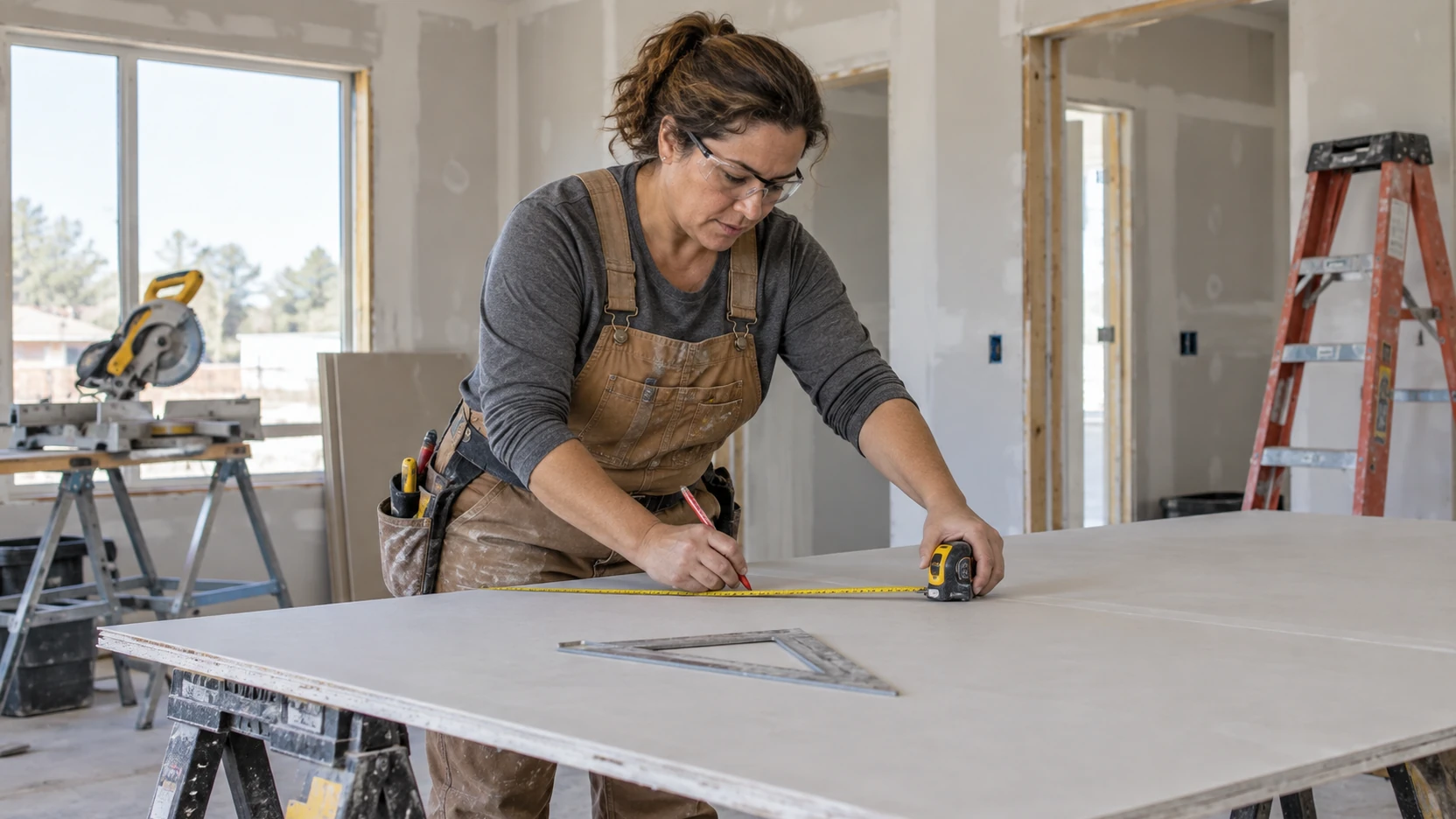
- Measure and mark surfaces to lay out work, according to blueprints or drawings, using tape measures, straightedges or squares, and marking devices.
- Cut and screw together metal channels to make floor or ceiling frames, according to plans for the location of rooms or hallways.
See 15 more tasks
- Hang drywall panels on metal frameworks of walls and ceilings in offices, schools, or other large buildings, using lifts or hoists to adjust panel heights, when necessary.
- Fit and fasten wallboard or drywall into position on wood or metal frameworks, using glue, nails, or screws.
- Measure and cut openings in panels or tiles for electrical outlets, windows, vents, plumbing, or other fixtures, using keyhole saws or other cutting tools.
- Cut metal or wood framing and trim to size, using cutting tools.
- Cut fixture or border tiles to size, using keyhole saws, and insert them into surrounding frameworks.
- Coordinate work with drywall finishers who cover the seams between drywall panels.
- Trim rough edges from wallboard to maintain even joints, using knives.
- Install horizontal and vertical metal or wooden studs to frames so that wallboard can be attached to interior walls.
- Fasten metal or rockboard lath to the structural framework of walls, ceilings, or partitions of buildings, using nails, screws, staples, or wire-ties.
- Install blanket insulation between studs and tack plastic moisture barriers over insulation.
- Assemble or install metal framing or decorative trim for windows, doorways, or vents.
- Scribe and cut edges of tile to fit walls where wall molding is not specified.
- Hang dry lines to wall moldings to guide positioning of main runners.
- Apply or mount acoustical tile or blocks, strips, or sheets of shock-absorbing materials to ceilings or walls of buildings to reduce reflection of sound or to decorate rooms.
- Remove existing plaster, drywall, or paneling, using crowbars and hammers.
A question about this career
Which part of this work would you like to see in person? Save this career to your Trail and keep the question beside it.
Open my TrailSkills, knowledge and working conditions
Skills used
- Critical Thinking
- Speaking
- Monitoring
- Reading Comprehension
- Coordination
- Judgment and Decision Making
- Time Management
- Complex Problem Solving
Knowledge that helps
- Building and Construction
- Mathematics
- Mechanical
- Public Safety and Security
- Administration and Management
- Design
- People contact
- Constant contact with others · 88% selected this answer
- In-person discussions
- Every day · 68% selected this answer
- Time standing
- Continually or almost continually · 92% selected this answer
- Decision freedom
- A lot of freedom · 54% selected this answer
Education and training
- Typical entry education
- No formal educational credential
- BLS figure for this job
- Overall preparation
- Job Zone 1–2
- Job Zone 1-2: Very Little to Some Preparation Needed
Training and experience
Usually requires a high school diploma or GED, though some occupations may not.
Moderate-term on-the-job training
Pay and employment
Median annual pay
$58,930
8 in 10 earn $38,460–$102,010 · May 2025 · BLS figure for this job
National job outlook
2025–35 · BLS figure for this job
Compare states on the map
Where people work
May 2025 · BLS state estimates
Hover to preview; select a state to keep its details. Zoom and scroll for a closer look, or use the state menu. On the map, arrow keys move through states alphabetically. Enter or Space selects a state.
These are jobs people already hold, not vacancies. Self-employed workers are not included.
About these figures and the map
Shading compares states with published estimates for Drywall and Ceiling Tile Installers. Concentration means jobs in this occupation per 1,000 employed people in a state. Total jobs means estimated employment, not openings. The figures exclude self-employed workers. Striped gray states have no published estimate for the selected measure; that does not mean no one works there.
Boundaries: US Atlas / US Census. Larger states occupy more map area; their size does not indicate more jobs.
Occupation interest pattern
Interest pattern
What this work leans on
Career ratings are out of 7. Your completed quiz totals are out of 50. These are different scales; the overall pattern matters, not equal bar lengths or ability.
- Building (Realistic)7.0Career rating 7.0 of 7. No personal quiz comparison.
- Organizing (Conventional)3.1Career rating 3.1 of 7. No personal quiz comparison.
- Creating (Artistic)2.3Career rating 2.3 of 7. No personal quiz comparison.
- Investigating (Investigative)2.0Career rating 2.0 of 7. No personal quiz comparison.
- Helping (Social)1.2Career rating 1.2 of 7. No personal quiz comparison.
- Leading (Enterprising)1.0Career rating 1.0 of 7. No personal quiz comparison.
More specific themes
- Construction/Woodwork
- Physical/Manual Labor
Related careers to explore
- Building Insulation Installers
- Drywall Tapers and Finishers
- Sheet Metal Workers
- Carpenters
- Plasterers and Stucco Masons
- Vinyl and Resilient Flooring Installers
- Roofers
- Mechanical Insulation Installers
- Tile and Stone Setters
- Rebar and Reinforcing Iron Workers
- Structural Steel and Iron Workers
- Brickmasons and Blockmasons
- Concrete Masons and Finishers
- Structural Metal Fabricators
- Construction Laborers
- Carpet Installers
- Terrazzo Flooring Installers
- Molders and Casters (Clay, Glass, Stone and More)
- Woodworking Machine Operators
Take a closer look
Investigate one question.
Choose something you still want to understand. Start with the information on this page, or look for a person describing their work.
- What does someone in this job spend time doing?
- What is challenging about the work, and how do they handle it?
- What changes when this job is done in a different workplace?
Find and check an example
This link searches Google in a new tab. Results have not been selected or checked by Kairos. Use your school’s browsing guidance; searching is optional.
The search uses this career’s public title, never your answers or notes.
- Check who made it, when it was made, and which job and workplace it describes.
- Look for a specific example that helps answer your question. A personal story describes one experience, not every job.
- Compare it with this page or a second source. Keep track of what is still uncertain.
For a closer comparison, explain why two people in the same occupation might describe different days.
If you want to return to this career, use “Save to my trail” above. In Trail, write a reason it interests you or a question to follow up.
Open my trail