
Brickmasons and Blockmasons
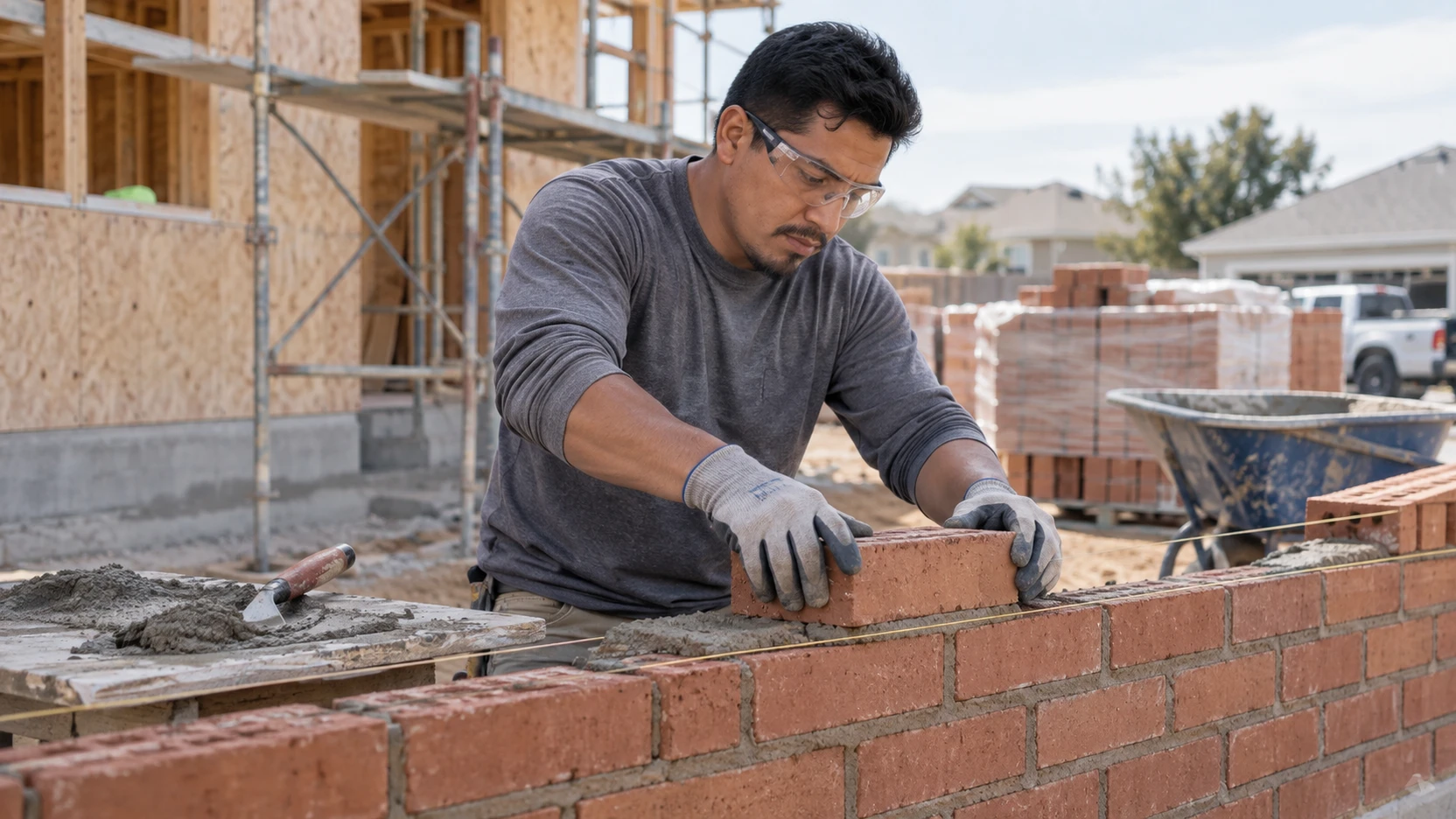
Brickmasons and blockmasons lay and bind building materials, such as brick, structural tile, concrete block, cinder block, glass block, and terra-cotta block, with mortar and other substances, to construct or repair walls, partitions, arches, sewers, and other structures.
Opening this tab’s Trail…
Fictional preview only. Closing this tab or clearing browser data can remove this work; no account or cloud sync.
What the work involves
O*NET task statements for this occupation.
- Measure distance from reference points and mark guidelines to lay out work, using plumb bobs and levels.
- Construct corners by fastening in plumb position a corner pole or building a corner pyramid of bricks, and filling in between the corners using a line from corner to corner to guide each course, or layer, of brick.
- Apply and smooth mortar or other mixture over work surface.
See 9 more tasks
- Calculate angles and courses and determine vertical and horizontal alignment of courses.
- Break or cut bricks, tiles, or blocks to size, using trowel edge, hammer, or power saw.
- Interpret blueprints and drawings to determine specifications and to calculate the materials required.
- Remove excess mortar with trowels and hand tools, and finish mortar joints with jointing tools, for a sealed, uniform appearance.
- Fasten or fuse brick or other building material to structure with wire clamps, anchor holes, torch, or cement.
- Clean working surface to remove scale, dust, soot, or chips of brick and mortar, using broom, wire brush, or scraper.
- Examine brickwork or structure to determine need for repair.
- Mix specified amounts of sand, clay, dirt, or mortar powder with water to form refractory mixtures.
- Remove burned or damaged brick or mortar, using sledgehammer, crowbar, chipping gun, or chisel.
A question about this career
Which part of this work would you like to see in person? Save this career to your Trail and keep the question beside it.
Open my TrailSkills, knowledge and working conditions
Skills used
- Critical Thinking
- Active Listening
- Speaking
- Monitoring
- Coordination
- Operations Monitoring
- Quality Control Analysis
- Time Management
Knowledge that helps
- Building and Construction
- Mathematics
- English Language
- Public Safety and Security
- Production and Processing
- Design
- Time sitting
- Never · 62% selected this answer
- Outside in the weather
- Every day · 97% selected this answer
- Teamwork
- Extremely important · 51% selected this answer
- In-person discussions
- Every day · 64% selected this answer
Education and training
- Typical entry education
- High school diploma or equivalent
- BLS figure for this job
- Overall preparation
- Job Zone 1–2
- Job Zone 1-2: Very Little to Some Preparation Needed
Training and experience
Usually requires a high school diploma or GED, though some occupations may not.
Apprenticeship
Pay and employment
Median annual pay
$62,120
8 in 10 earn $44,820–$100,010 · May 2025 · BLS figure for this job
National job outlook
2025–35 · BLS figure for this job
Compare states on the map
Where people work
May 2025 · BLS state estimates
Hover to preview; select a state to keep its details. Zoom and scroll for a closer look, or use the state menu. On the map, arrow keys move through states alphabetically. Enter or Space selects a state.
These are jobs people already hold, not vacancies. Self-employed workers are not included.
About these figures and the map
Shading compares states with published estimates for Brickmasons and Blockmasons. Concentration means jobs in this occupation per 1,000 employed people in a state. Total jobs means estimated employment, not openings. The figures exclude self-employed workers. Striped gray states have no published estimate for the selected measure; that does not mean no one works there.
Boundaries: US Atlas / US Census. Larger states occupy more map area; their size does not indicate more jobs.
Occupation interest pattern
Interest pattern
What this work leans on
Career ratings are out of 7. Your completed quiz totals are out of 50. These are different scales; the overall pattern matters, not equal bar lengths or ability.
- Building (Realistic)7.0Career rating 7.0 of 7. No personal quiz comparison.
- Organizing (Conventional)3.8Career rating 3.8 of 7. No personal quiz comparison.
- Investigating (Investigative)2.0Career rating 2.0 of 7. No personal quiz comparison.
- Creating (Artistic)1.7Career rating 1.7 of 7. No personal quiz comparison.
- Leading (Enterprising)1.2Career rating 1.2 of 7. No personal quiz comparison.
- Helping (Social)1.1Career rating 1.1 of 7. No personal quiz comparison.
More specific themes
- Construction/Woodwork
- Physical/Manual Labor
Related careers to explore
- Stonemasons
- Tile and Stone Setters
- Concrete Masons and Finishers
- Terrazzo Flooring Installers
- Carpenters
- Vinyl and Resilient Flooring Installers
- Building Insulation Installers
- Construction Laborers
- Plasterers and Stucco Masons
- Drywall and Ceiling Tile Installers
- Molders and Casters (Clay, Glass, Stone and More)
- Structural Steel and Iron Workers
- Rebar and Reinforcing Iron Workers
- Mechanical Insulation Installers
- Sheet Metal Workers
- Glass Installers (Glaziers)
- Structural Metal Fabricators
- Boilermakers
Take a closer look
Investigate one question.
Choose something you still want to understand. Start with the information on this page, or look for a person describing their work.
- What does someone in this job spend time doing?
- What is challenging about the work, and how do they handle it?
- What changes when this job is done in a different workplace?
Find and check an example
This link searches Google in a new tab. Results have not been selected or checked by Kairos. Use your school’s browsing guidance; searching is optional.
The search uses this career’s public title, never your answers or notes.
- Check who made it, when it was made, and which job and workplace it describes.
- Look for a specific example that helps answer your question. A personal story describes one experience, not every job.
- Compare it with this page or a second source. Keep track of what is still uncertain.
For a closer comparison, explain why two people in the same occupation might describe different days.
If you want to return to this career, use “Save to my trail” above. In Trail, write a reason it interests you or a question to follow up.
Open my trail