
Wildlife Conservation Officers
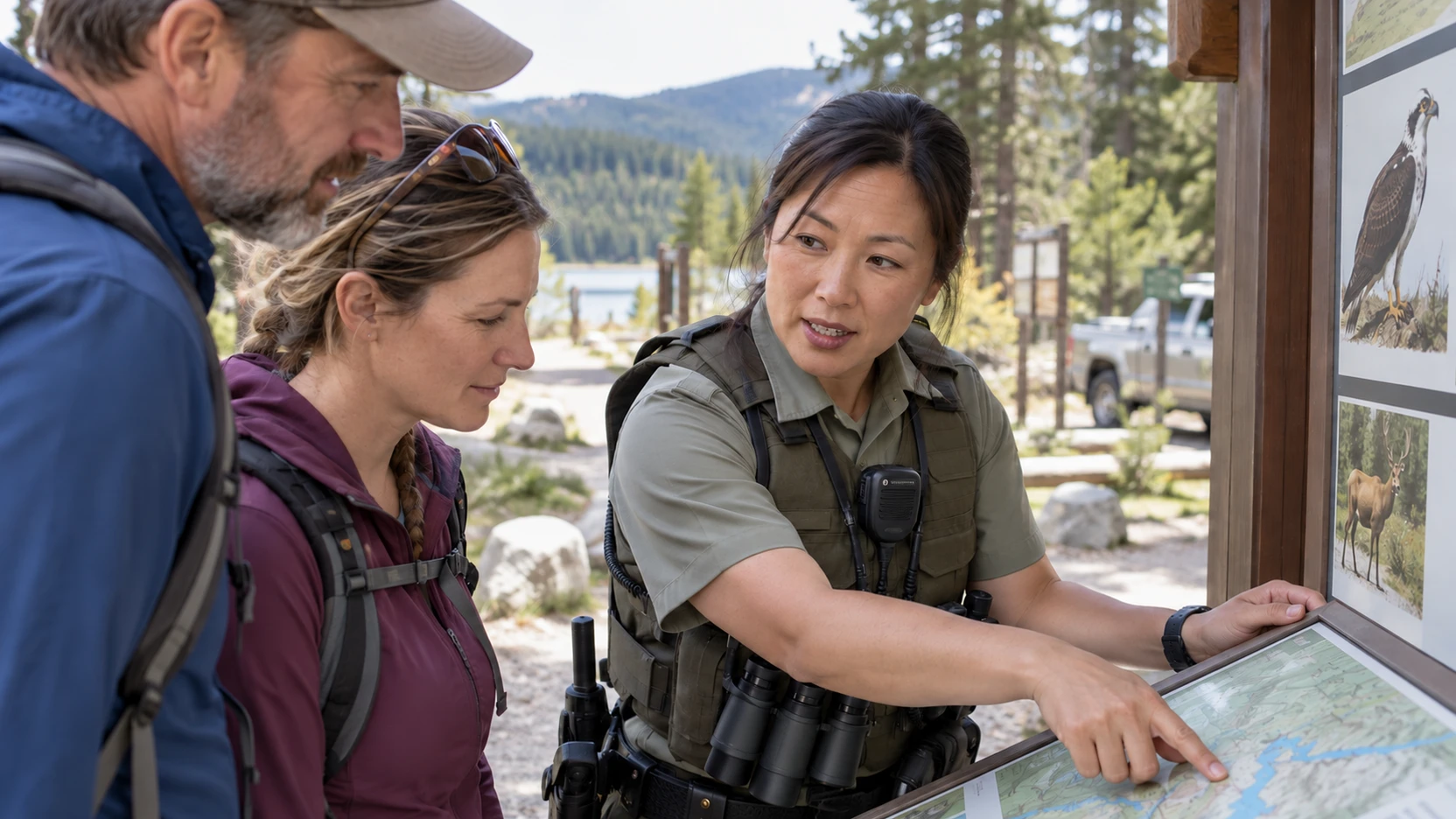
Wildlife conservation officers patrol assigned area to prevent fish and game law violations.
Opening this tab’s Trail…
Fictional preview only. Closing this tab or clearing browser data can remove this work; no account or cloud sync.
What the work involves
O*NET task statements for this occupation.
- Participate in search-and-rescue operations.
- Compile and present evidence for court actions.
- Protect and preserve native wildlife, plants, or ecosystems.
See 12 more tasks
- Patrol assigned areas by car, boat, airplane, horse, or on foot to enforce game, fish, or boating laws or to manage wildlife programs, lakes, or land.
- Investigate hunting accidents or reports of fish or game law violations.
- Provide assistance to other local law enforcement agencies as required.
- Issue warnings or citations and file reports as necessary.
- Provide advice or information to park or reserve visitors.
- Serve warrants and make arrests.
- Arrange for disposition of fish or game illegally taken or possessed.
- Promote or provide hunter or trapper safety training.
- Seize equipment used in fish and game law violations.
- Address schools, civic groups, sporting clubs, or the media to disseminate information concerning wildlife conservation and regulations.
- Recommend revisions in hunting and trapping regulations or in animal management programs so that wildlife balances or habitats can be maintained.
- Issue licenses, permits, or other documentation.
A question about this career
Which part of this work would you like to see in person? Save this career to your Trail and keep the question beside it.
Open my TrailSkills, knowledge and working conditions
Skills used
- Speaking
- Reading Comprehension
- Active Listening
- Critical Thinking
- Judgment and Decision Making
- Social Perceptiveness
- Persuasion
- Systems Analysis
Knowledge that helps
- Public Safety and Security
- Law and Government
- Customer and Personal Service
- English Language
- Telecommunications
- Psychology
Education and training
- Typical entry education
- Bachelor's degree
- BLS figure for this job
- Overall preparation
- Job Zone 3
- Job Zone Three: Medium Preparation Needed
Training and experience
Most occupations in this zone require training in vocational schools, related on-the-job experience, or an associate's degree.
Moderate-term on-the-job training
Pay and employment
Median annual pay
$74,060
8 in 10 earn $50,990–$100,980 · May 2025 · BLS figure for this job
National job outlook
2025–35 · BLS figure for this job
Compare states on the map
Where people work
May 2025 · BLS state estimates
Hover to preview; select a state to keep its details. Zoom and scroll for a closer look, or use the state menu. On the map, arrow keys move through states alphabetically. Enter or Space selects a state.
These are jobs people already hold, not vacancies. Self-employed workers are not included.
About these figures and the map
Shading compares states with published estimates for Fish and Game Wardens. Concentration means jobs in this occupation per 1,000 employed people in a state. Total jobs means estimated employment, not openings. The figures exclude self-employed workers. Striped gray states have no published estimate for the selected measure; that does not mean no one works there.
Boundaries: US Atlas / US Census. Larger states occupy more map area; their size does not indicate more jobs.
Occupation interest pattern
Interest pattern
What this work leans on
Career ratings are out of 7. Your completed quiz totals are out of 50. These are different scales; the overall pattern matters, not equal bar lengths or ability.
- Building (Realistic)6.4Career rating 6.4 of 7. No personal quiz comparison.
- Organizing (Conventional)4.2Career rating 4.2 of 7. No personal quiz comparison.
- Investigating (Investigative)3.9Career rating 3.9 of 7. No personal quiz comparison.
- Leading (Enterprising)3.0Career rating 3.0 of 7. No personal quiz comparison.
- Helping (Social)2.4Career rating 2.4 of 7. No personal quiz comparison.
- Creating (Artistic)1.0Career rating 1.0 of 7. No personal quiz comparison.
More specific themes
- Transportation/Machine Operation
- Protective Service
- Nature/Outdoors
Related careers to explore
- Animal Control Workers
- Conservation Scientists
- Forest and Conservation Technicians
- Forest and Conservation Workers
- Wildfire Inspectors and Prevention Specialists
- Park Naturalists
- Fishing and Hunting Workers
- Environmental Compliance Inspectors
- Police Officers
- Zoologists and Wildlife Biologists
- Environmental Restoration Planners
- Environmental Scientists
- Foresters
- Biologists
- Lifeguards, Ski Patrol and Recreation Rescuers
- College Forestry and Conservation Teachers
- Fire Service Supervisors
- Agriculture, Fishing and Forestry Supervisors
Take a closer look
Investigate one question.
Choose something you still want to understand. Start with the information on this page, or look for a person describing their work.
- What does someone in this job spend time doing?
- What is challenging about the work, and how do they handle it?
- What changes when this job is done in a different workplace?
Find and check an example
This link searches Google in a new tab. Results have not been selected or checked by Kairos. Use your school’s browsing guidance; searching is optional.
The search uses this career’s public title, never your answers or notes.
- Check who made it, when it was made, and which job and workplace it describes.
- Look for a specific example that helps answer your question. A personal story describes one experience, not every job.
- Compare it with this page or a second source. Keep track of what is still uncertain.
For a closer comparison, explain why two people in the same occupation might describe different days.
If you want to return to this career, use “Save to my trail” above. In Trail, write a reason it interests you or a question to follow up.
Open my trail