
Environmental Restoration Planners
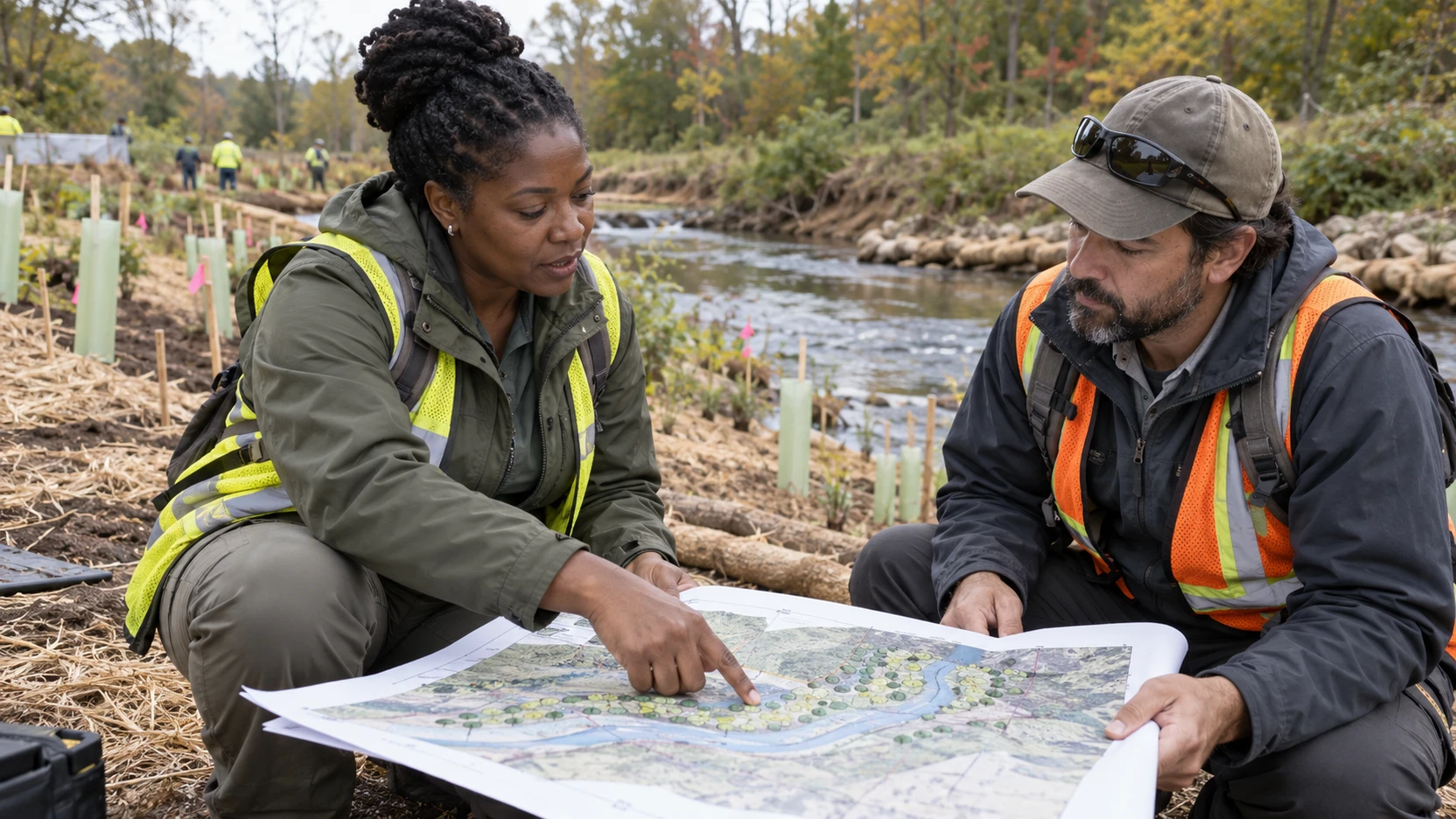
Environmental restoration planners collaborate with field and biology staff to oversee the implementation of restoration projects and to develop new products.
Opening this tab’s Trail…
Fictional preview only. Closing this tab or clearing browser data can remove this work; no account or cloud sync.
What the work involves
O*NET task statements for this occupation.
- Develop environmental restoration project schedules and budgets.
- Provide technical direction on environmental planning to energy engineers, biologists, geologists, or other professionals working to develop restoration plans or strategies.
- Create habitat management or restoration plans, such as native tree restoration and weed control.
See 20 more tasks
- Conduct site assessments to certify a habitat or to ascertain environmental damage or restoration needs.
- Collect and analyze data to determine environmental conditions and restoration needs.
- Supervise and provide technical guidance, training, or assistance to employees working in the field to restore habitats.
- Plan environmental restoration projects, using biological databases, environmental strategies, and planning software.
- Communicate findings of environmental studies or proposals for environmental remediation to other restoration professionals.
- Apply for permits required for the implementation of environmental remediation projects.
- Inspect active remediation sites to ensure compliance with environmental or safety policies, standards, or regulations.
- Develop natural resource management plans, using knowledge of environmental planning or state and federal environmental regulatory requirements.
- Identify environmental mitigation alternatives, ensuring compliance with applicable standards, laws, or regulations.
- Identify short- and long-term impacts of environmental remediation activities.
- Notify regulatory or permitting agencies of deviations from implemented remediation plans.
- Write grants to obtain funding for restoration projects.
- Plan or supervise environmental studies to achieve compliance with environmental regulations in construction, modification, operation, acquisition, or divestiture of facilities such as power plants.
- Review existing environmental remediation designs.
- Develop and communicate recommendations for landowners to maintain or restore environmental conditions.
- Conduct feasibility and cost-benefit studies for environmental remediation projects.
- Conduct environmental impact studies to examine the ecological effects of pollutants, disease, human activities, nature, and climate change.
- Create environmental models or simulations, using geographic information system (GIS) data and knowledge of particular ecosystems or ecological regions.
- Create diagrams to communicate environmental remediation planning, using geographic information systems (GIS), computer-aided design (CAD), or other mapping or diagramming software.
- Develop environmental management or restoration plans for sites with power transmission lines, natural gas pipelines, fuel refineries, geothermal plants, wind farms, or solar farms.
A question about this career
Which part of this work would you like to see in person? Save this career to your Trail and keep the question beside it.
Open my TrailSkills, knowledge and working conditions
Skills used
- Critical Thinking
- Reading Comprehension
- Active Listening
- Writing
- Complex Problem Solving
- Judgment and Decision Making
- Systems Analysis
- Systems Evaluation
Knowledge that helps
- Biology
- English Language
- Geography
- Design
- Mathematics
- Administration and Management
- People contact
- Contact with others most of the time · 64% selected this answer
- Time sitting
- About half the time · 45% selected this answer
- Outside in the weather
- Once a month or more but not every week · 45% selected this answer
- Teamwork
- Extremely important · 67% selected this answer
Education and training
- Typical entry education
- Bachelor's degree
- BLS group: Environmental scientists and specialists, including health
- Overall preparation
- Job Zone 5
- Job Zone Five: Extensive Preparation Needed
Training and experience
Most of these occupations require graduate school. For example, they may require a master's degree, and some require a Ph.D., M.D., or J.D. (law degree).
None
Pay and employment
Median annual pay
$82,220
8 in 10 earn $52,520–$140,010 · May 2025 · BLS group: Environmental scientists and specialists, including health
National job outlook
2025–35 · BLS group: Environmental scientists and specialists, including health
Compare states on the map
Where people work
May 2025 · BLS state estimates
Hover to preview; select a state to keep its details. Zoom and scroll for a closer look, or use the state menu. On the map, arrow keys move through states alphabetically. Enter or Space selects a state.
These are jobs people already hold, not vacancies. Self-employed workers are not included.
About these figures and the map
Shading compares states with published estimates for Environmental Scientists and Specialists, Including Health. Concentration means jobs in this occupation per 1,000 employed people in a state. Total jobs means estimated employment, not openings. The figures exclude self-employed workers. Striped gray states have no published estimate for the selected measure; that does not mean no one works there.
Boundaries: US Atlas / US Census. Larger states occupy more map area; their size does not indicate more jobs.
Occupation interest pattern
Interest pattern
What this work leans on
Career ratings are out of 7. Your completed quiz totals are out of 50. These are different scales; the overall pattern matters, not equal bar lengths or ability.
- Investigating (Investigative)6.3Career rating 6.3 of 7. No personal quiz comparison.
- Building (Realistic)5.3Career rating 5.3 of 7. No personal quiz comparison.
- Organizing (Conventional)4.1Career rating 4.1 of 7. No personal quiz comparison.
- Leading (Enterprising)3.6Career rating 3.6 of 7. No personal quiz comparison.
- Creating (Artistic)2.2Career rating 2.2 of 7. No personal quiz comparison.
- Helping (Social)2.1Career rating 2.1 of 7. No personal quiz comparison.
Related careers to explore
- Conservation Scientists
- Land Cleanup and Redevelopment Specialists
- Environmental Scientists
- Water Resource Specialists
- Environmental Engineers
- Hydrologists
- Climate Change Policy Analysts
- Hydrologic Technicians
- Forest and Conservation Technicians
- Foresters
- Soil and Plant Scientists
- Zoologists and Wildlife Biologists
- Environmental Science Technicians
- Civil Engineers
- Earth Scientists (Geoscientists)
- Biologists
Take a closer look
Investigate one question.
Choose something you still want to understand. Start with the information on this page, or look for a person describing their work.
- What does someone in this job spend time doing?
- What is challenging about the work, and how do they handle it?
- What changes when this job is done in a different workplace?
Find and check an example
This link searches Google in a new tab. Results have not been selected or checked by Kairos. Use your school’s browsing guidance; searching is optional.
The search uses this career’s public title, never your answers or notes.
- Check who made it, when it was made, and which job and workplace it describes.
- Look for a specific example that helps answer your question. A personal story describes one experience, not every job.
- Compare it with this page or a second source. Keep track of what is still uncertain.
For a closer comparison, explain why two people in the same occupation might describe different days.
If you want to return to this career, use “Save to my trail” above. In Trail, write a reason it interests you or a question to follow up.
Open my trail