
Firefighters
Firefighters control and put out fires and respond to emergencies involving life, property, or the environment.
Opening this tab’s Trail…
Fictional preview only. Closing this tab or clearing browser data can remove this work; no account or cloud sync.
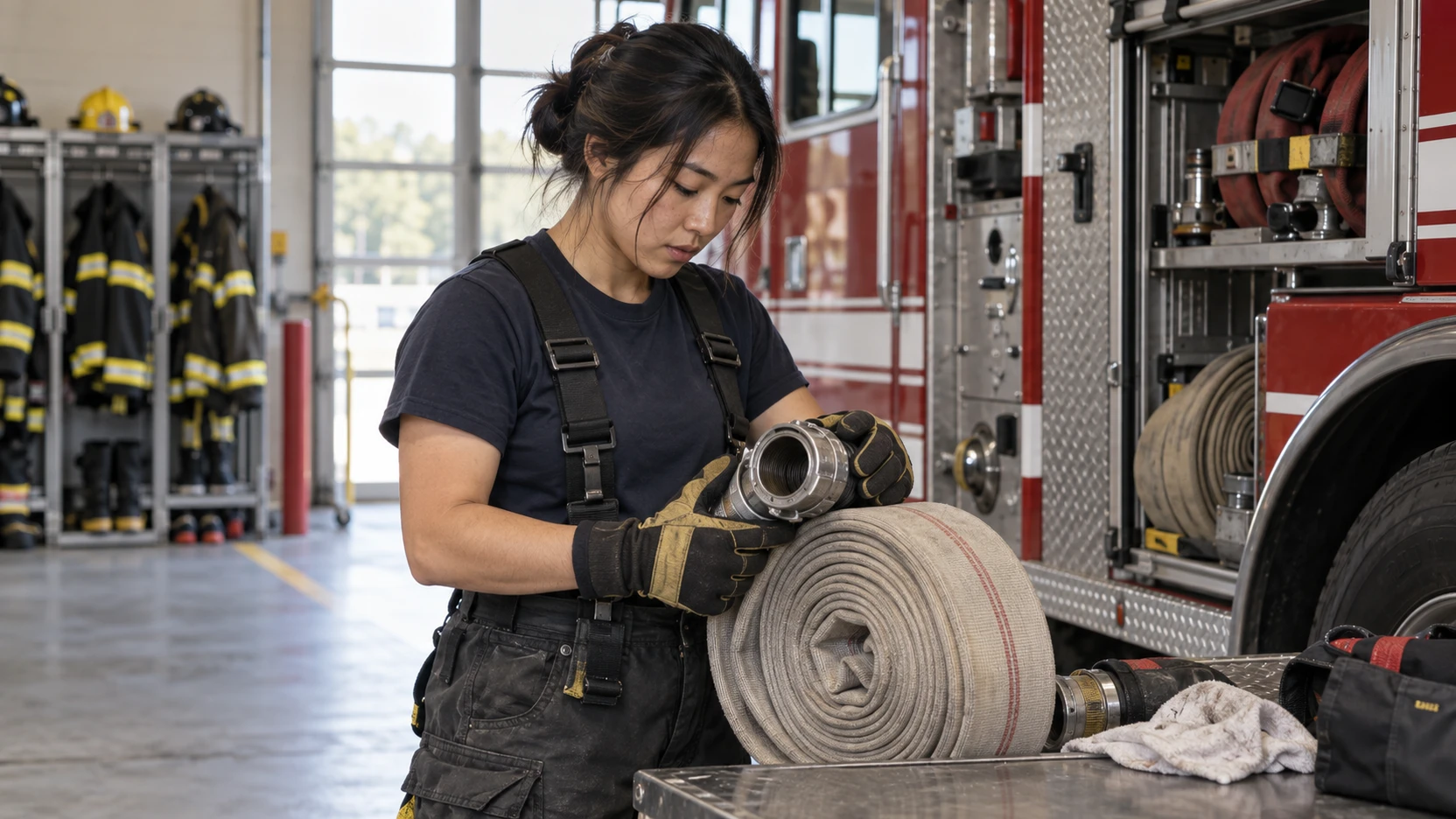
What the work involves
O*NET task statements for this occupation.
- Rescue survivors from burning buildings, accident sites, and water hazards.
- Administer first aid and cardiopulmonary resuscitation to injured persons or provide emergency medical care such as basic or advanced life support.
- Dress with equipment such as fire-resistant clothing and breathing apparatus.
See 21 more tasks
- Move toward the source of a fire, using knowledge of types of fires, construction design, building materials, and physical layout of properties.
- Drive and operate fire fighting vehicles and equipment.
- Respond to fire alarms and other calls for assistance, such as automobile and industrial accidents.
- Search to locate fire survivors.
- Operate pumps connected to high-pressure hoses.
- Maintain contact with fire dispatchers at all times to notify them of the need for additional firefighters and supplies, or to detail any difficulties encountered.
- Extinguish flames and embers to suppress fires, using shovels or engine- or hand-driven water or chemical pumps.
- Maintain knowledge of current firefighting practices by participating in drills and by attending seminars, conventions, and conferences.
- Select and attach hose nozzles, depending on fire type, and direct streams of water or chemicals onto fires.
- Collaborate with other firefighters as a member of a firefighting crew.
- Train new employees to control and suppress fires.
- Position and climb ladders to gain access to upper levels of buildings, or to rescue individuals from burning structures.
- Create openings in buildings for ventilation or entrance, using axes, chisels, crowbars, electric saws, or core cutters.
- Participate in fire drills and demonstrations of fire fighting techniques.
- Assess fires and situations and report conditions to superiors to receive instructions, using two-way radios.
- Inspect fire sites after flames have been extinguished to ensure that there is no further danger.
- Patrol burned areas after fires to locate and eliminate hot spots that may restart fires.
- Take action to contain any hazardous chemicals that could catch fire, leak, or spill.
- Prepare written reports that detail specifics of fire incidents.
- Protect property from water and smoke, using waterproof salvage covers, smoke ejectors, and deodorants.
- Inspect buildings for fire hazards and compliance with fire prevention ordinances, testing and checking smoke alarms and fire suppression equipment as necessary.
A question about this career
Which part of this work would you like to see in person? Save this career to your Trail and keep the question beside it.
Open my TrailSkills, knowledge and working conditions
Skills used
- Active Listening
- Critical Thinking
- Active Learning
- Speaking
- Coordination
- Service Orientation
- Judgment and Decision Making
- Social Perceptiveness
Knowledge that helps
- Public Safety and Security
- Transportation
- Customer and Personal Service
- Medicine and Dentistry
- Mechanical
- Communications and Media
- People contact
- Constant contact with others · 38% selected this answer
- Time sitting
- Less than half the time · 77% selected this answer
- Outside in the weather
- Once a week or more but not every day · 44% selected this answer
- Teamwork
- Extremely important · 57% selected this answer
Education and training
- Typical entry education
- Postsecondary nondegree award
- BLS figure for this job
- Overall preparation
- Job Zone 1–2
- Job Zone 1-2: Very Little to Some Preparation Needed
Training and experience
Usually requires a high school diploma or GED, though some occupations may not.
Long-term on-the-job training
Pay and employment
Median annual pay
$59,280
8 in 10 earn $34,910–$101,040 · May 2025 · BLS figure for this job
National job outlook
2025–35 · BLS figure for this job
Compare states on the map
Where people work
May 2025 · BLS state estimates
Hover to preview; select a state to keep its details. Zoom and scroll for a closer look, or use the state menu. On the map, arrow keys move through states alphabetically. Enter or Space selects a state.
These are jobs people already hold, not vacancies. Self-employed workers are not included.
About these figures and the map
Shading compares states with published estimates for Firefighters. Concentration means jobs in this occupation per 1,000 employed people in a state. Total jobs means estimated employment, not openings. The figures exclude self-employed workers. Striped gray states have no published estimate for the selected measure; that does not mean no one works there.
Boundaries: US Atlas / US Census. Larger states occupy more map area; their size does not indicate more jobs.
Occupation interest pattern
Interest pattern
What this work leans on
Career ratings are out of 7. Your completed quiz totals are out of 50. These are different scales; the overall pattern matters, not equal bar lengths or ability.
- Building (Realistic)6.5Career rating 6.5 of 7. No personal quiz comparison.
- Organizing (Conventional)3.5Career rating 3.5 of 7. No personal quiz comparison.
- Helping (Social)3.4Career rating 3.4 of 7. No personal quiz comparison.
- Leading (Enterprising)3.0Career rating 3.0 of 7. No personal quiz comparison.
- Investigating (Investigative)2.9Career rating 2.9 of 7. No personal quiz comparison.
- Creating (Artistic)1.3Career rating 1.3 of 7. No personal quiz comparison.
More specific themes
- Transportation/Machine Operation
- Protective Service
- Physical/Manual Labor
Related careers to explore
- Fire Service Supervisors
- Wildfire Inspectors and Prevention Specialists
- Fire Inspectors and Investigators
- Fire Protection Engineers
- Lifeguards, Ski Patrol and Recreation Rescuers
- Emergency Medical Technicians
- Paramedics
- Workplace Health and Safety Specialists
- Forest and Conservation Workers
- Ship Engineers
- Workplace Health and Safety Technicians
- Security Guards
- Hazardous Material Removal Specialists
- Emergency Management Directors
- Stationary Engine and Boiler Operators
- Health and Safety Engineers
- Forest and Conservation Technicians
- Ship Deck and Engine-Room Crew
- Electrical Power Line Technicians
Take a closer look
Investigate one question.
Choose something you still want to understand. Start with the information on this page, or look for a person describing their work.
- What does someone in this job spend time doing?
- What is challenging about the work, and how do they handle it?
- What changes when this job is done in a different workplace?
Find and check an example
This link searches Google in a new tab. Results have not been selected or checked by Kairos. Use your school’s browsing guidance; searching is optional.
The search uses this career’s public title, never your answers or notes.
- Check who made it, when it was made, and which job and workplace it describes.
- Look for a specific example that helps answer your question. A personal story describes one experience, not every job.
- Compare it with this page or a second source. Keep track of what is still uncertain.
For a closer comparison, explain why two people in the same occupation might describe different days.
If you want to return to this career, use “Save to my trail” above. In Trail, write a reason it interests you or a question to follow up.
Open my trail