
Shuttle Drivers and Chauffeurs
Shuttle drivers and chauffeurs drive a motor vehicle to transport passengers on a planned or scheduled basis.
Opening this tab’s Trail…
Fictional preview only. Closing this tab or clearing browser data can remove this work; no account or cloud sync.
What the work involves
O*NET task statements for this occupation.
- Test vehicle equipment, such as lights, brakes, horns, or windshield wipers, to ensure proper operation.
- Check the condition of a vehicle's tires, brakes, windshield wipers, lights, oil, fuel, water, and safety equipment to ensure that everything is in working order.
- Comply with traffic regulations to operate vehicles in a safe and courteous manner.
See 20 more tasks
- Follow relevant safety regulations and state laws governing vehicle operation, and ensure that passengers follow safety regulations.
- Operate vehicles with specialized equipment, such as wheelchair lifts, to transport and secure passengers with special needs.
- Report any vehicle malfunctions or needed repairs.
- Perform routine vehicle maintenance, such as regulating tire pressure and adding gasoline, oil, and water.
- Pick up and drop off passengers at regularly scheduled neighborhood locations, following strict time schedules.
- Drive shuttle busses, limousines, company cars, or privately owned vehicles to transport passengers.
- Prepare and submit reports that may include the number of passengers or trips, hours worked, mileage driven fuel consumed, or fares received.
- Notify dispatchers or company mechanics of vehicle problems.
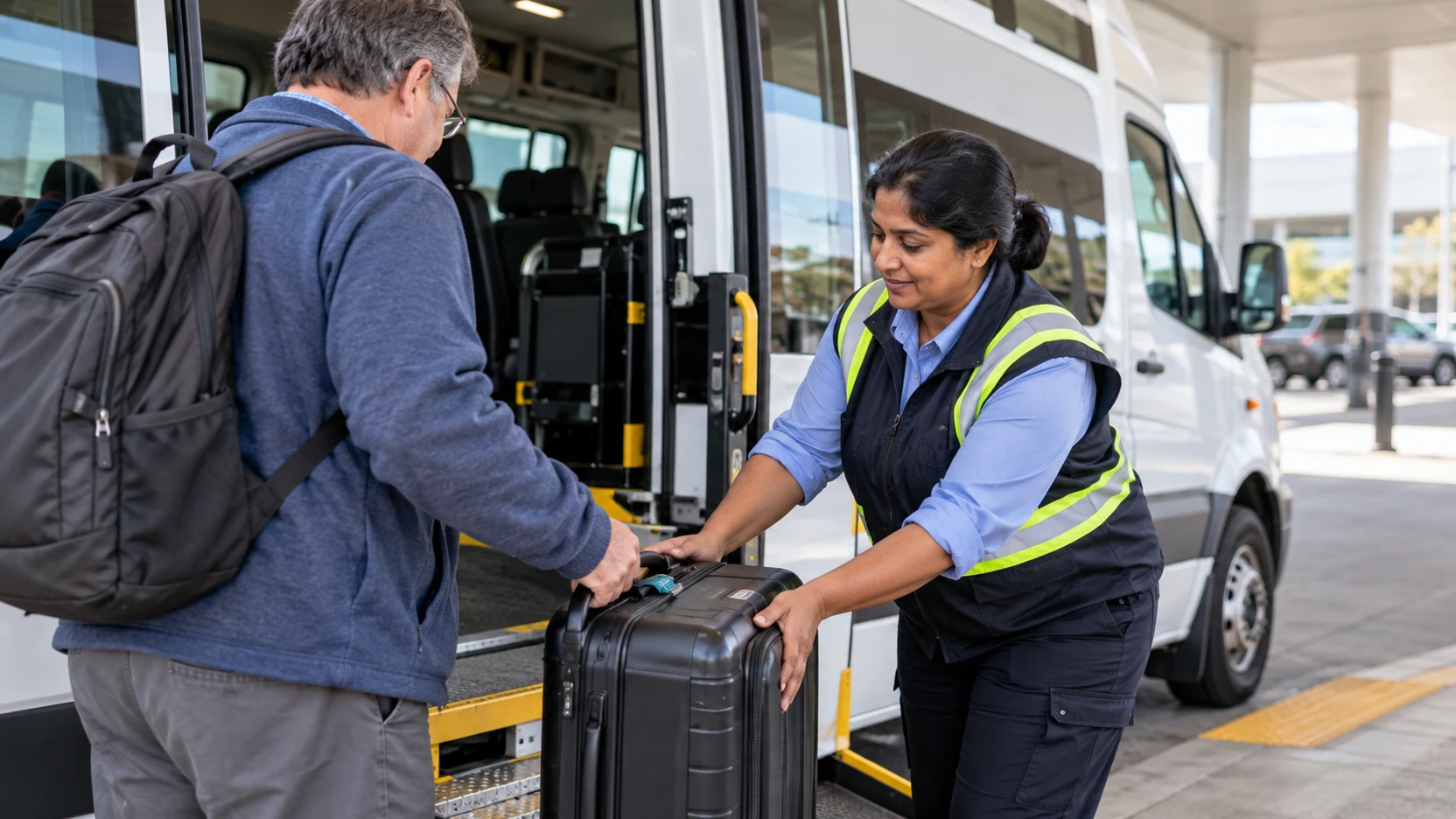
- Provide passengers with assistance entering and exiting vehicles, and help them with any luggage.
- Communicate with dispatchers by radio, telephone, or computer to exchange information and receive requests for passenger service.
- Pick up or meet passengers according to requests, appointments, or schedules.
- Arrange to pick up particular customers or groups on a regular schedule.
- Report delays, accidents, or other traffic and transportation situations, using telephones or mobile two-way radios.
- Complete accident reports when necessary.
- Read maps and follow written and verbal geographic directions.
- Maintain knowledge of first-aid procedures.
- Regulate heating, lighting, and ventilation systems for passenger comfort.
- Record vehicle routes.
- Vacuum and clean interiors, and wash and polish exteriors of automobiles.
- Provide passengers with information or advice about the local area, points of interest, hotels, or restaurants.
A question about this career
Which part of this work would you like to see in person? Save this career to your Trail and keep the question beside it.
Open my TrailSkills, knowledge and working conditions
Skills used
- Active Listening
- Critical Thinking
- Monitoring
- Speaking
- Operation and Control
- Social Perceptiveness
- Service Orientation
- Operations Monitoring
Knowledge that helps
- Customer and Personal Service
- Transportation
- Public Safety and Security
- English Language
- Personnel and Human Resources
- Administrative
- People contact
- Constant contact with others · 63% selected this answer
- Outside in the weather
- Every day · 73% selected this answer
- Teamwork
- Very important · 43% selected this answer
- Time standing
- Less than half the time · 70% selected this answer
Education and training
- Typical entry education
- No formal educational credential
- BLS figure for this job
- Overall preparation
- Job Zone 1–2
- Job Zone 1-2: Very Little to Some Preparation Needed
Training and experience
Usually requires a high school diploma or GED, though some occupations may not.
Short-term on-the-job training
Pay and employment
Median annual pay
$37,290
8 in 10 earn $28,090–$55,070 · May 2025 · BLS figure for this job
National job outlook
2025–35 · BLS figure for this job
Compare states on the map
Where people work
May 2025 · BLS state estimates
Hover to preview; select a state to keep its details. Zoom and scroll for a closer look, or use the state menu. On the map, arrow keys move through states alphabetically. Enter or Space selects a state.
These are jobs people already hold, not vacancies. Self-employed workers are not included.
About these figures and the map
Shading compares states with published estimates for Shuttle Drivers and Chauffeurs. Concentration means jobs in this occupation per 1,000 employed people in a state. Total jobs means estimated employment, not openings. The figures exclude self-employed workers. Striped gray states have no published estimate for the selected measure; that does not mean no one works there.
Boundaries: US Atlas / US Census. Larger states occupy more map area; their size does not indicate more jobs.
Occupation interest pattern
Interest pattern
What this work leans on
Career ratings are out of 7. Your completed quiz totals are out of 50. These are different scales; the overall pattern matters, not equal bar lengths or ability.
- Building (Realistic)6.5Career rating 6.5 of 7. No personal quiz comparison.
- Organizing (Conventional)4.2Career rating 4.2 of 7. No personal quiz comparison.
- Helping (Social)3.0Career rating 3.0 of 7. No personal quiz comparison.
- Leading (Enterprising)2.1Career rating 2.1 of 7. No personal quiz comparison.
- Investigating (Investigative)1.0Career rating 1.0 of 7. No personal quiz comparison.
- Creating (Artistic)1.0Career rating 1.0 of 7. No personal quiz comparison.
More specific themes
- Personal Service
- Transportation/Machine Operation
Related careers to explore
- Taxi Drivers
- Transit and Intercity Bus Drivers
- Light Truck Drivers
- Heavy Truck and Tractor-Trailer Drivers
- Passenger Attendants
- Service and Transportation Dispatchers
- Train Conductors and Yardmasters
- Subway and Streetcar Operators
- School Bus Drivers
- Travel Reservations and Ticket Agents
- Train Drivers (Locomotive Engineers)
- Industrial Forklift and Tractor Operators
- Underground Mining Loader Operators
- Delivery Sales Drivers
- Diesel and Heavy Vehicle Mechanics
- Rail Car Repairers
Take a closer look
Investigate one question.
Choose something you still want to understand. Start with the information on this page, or look for a person describing their work.
- What does someone in this job spend time doing?
- What is challenging about the work, and how do they handle it?
- What changes when this job is done in a different workplace?
Find and check an example
This link searches Google in a new tab. Results have not been selected or checked by Kairos. Use your school’s browsing guidance; searching is optional.
The search uses this career’s public title, never your answers or notes.
- Check who made it, when it was made, and which job and workplace it describes.
- Look for a specific example that helps answer your question. A personal story describes one experience, not every job.
- Compare it with this page or a second source. Keep track of what is still uncertain.
For a closer comparison, explain why two people in the same occupation might describe different days.
If you want to return to this career, use “Save to my trail” above. In Trail, write a reason it interests you or a question to follow up.
Open my trail