
Metal and Plastic Lathe Operators
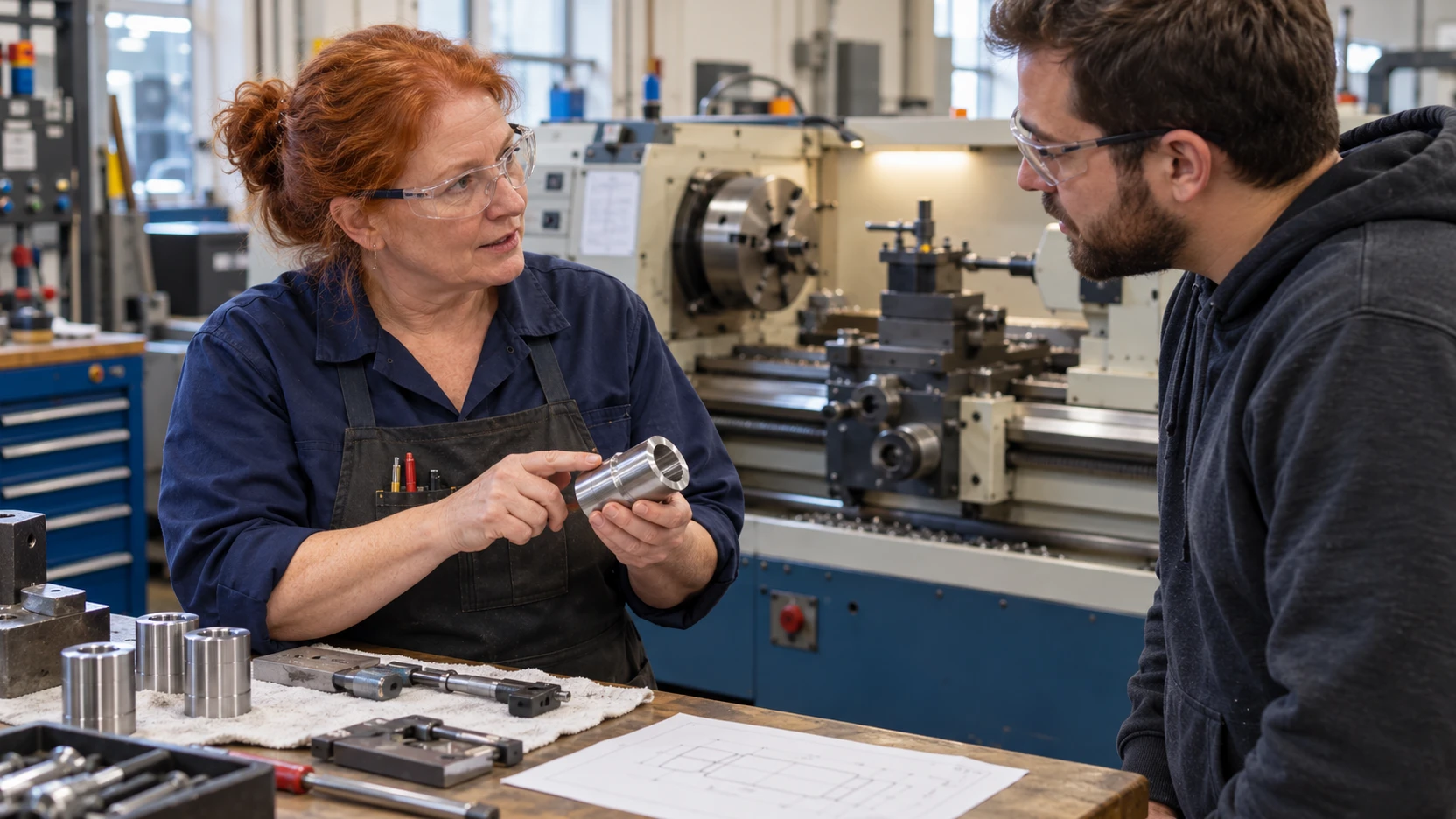
Metal and plastic lathe operators set up, operate, or tend lathe and turning machines to turn, bore, thread, form, or face metal or plastic materials, such as wire, rod, or bar stock.
Opening this tab’s Trail…
Fictional preview only. Closing this tab or clearing browser data can remove this work; no account or cloud sync.
What the work involves
O*NET task statements for this occupation.
- Adjust machine controls and change tool settings to keep dimensions within specified tolerances.
- Move controls to set cutting speeds and depths and feed rates, and to position tools in relation to workpieces.
- Study blueprints, layouts or charts, and job orders for information on specifications and tooling instructions, and to determine material requirements and operational sequences.
See 15 more tasks
- Inspect sample workpieces to verify conformance with specifications, using instruments such as gauges, micrometers, and dial indicators.
- Replace worn tools, and sharpen dull cutting tools and dies, using bench grinders or cutter-grinding machines.
- Move toolholders manually or by turning handwheels, or engage automatic feeding mechanisms to feed tools to and along workpieces.
- Compute unspecified dimensions and machine settings, using knowledge of metal properties and shop mathematics.
- Crank machines through cycles, stopping to adjust tool positions and machine controls to ensure specified timing, clearances, and tolerances.
- Position, secure, and align cutting tools in toolholders on machines, using hand tools, and verify their positions with measuring instruments.
- Start lathe or turning machines and observe operations to ensure that specifications are met.
- Program computer numerical control machines.
- Refill, change, and monitor the level of fluids, such as oil and coolant, in machines.
- Clean work area.
- Lift metal stock or workpieces manually or using hoists, and position and secure them in machines, using fasteners and hand tools.
- Install holding fixtures, cams, gears, and stops to control stock and tool movement, using hand tools, power tools, and measuring instruments.
- Select cutting tools and tooling instructions, according to written specifications or knowledge of metal properties and shop mathematics.
- Mount attachments, such as relieving or tracing attachments, to perform operations, such as duplicating contours of templates or trimming workpieces.
- Turn valve handles to direct the flow of coolant onto work areas or to coat disks with spinning compounds.
A question about this career
Which part of this work would you like to see in person? Save this career to your Trail and keep the question beside it.
Open my TrailSkills, knowledge and working conditions
Skills used
- Reading Comprehension
- Active Listening
- Monitoring
- Speaking
- Operations Monitoring
- Operation and Control
- Equipment Maintenance
- Quality Control Analysis
Knowledge that helps
- Production and Processing
- Mechanical
- Engineering and Technology
- Education and Training
- Administration and Management
- Customer and Personal Service
- People contact
- Occasional contact with others · 37% selected this answer
- Time sitting
- Less than half the time · 61% selected this answer
Education and training
- Typical entry education
- High school diploma or equivalent
- BLS figure for this job
- Overall preparation
- Job Zone 1–2
- Job Zone 1-2: Very Little to Some Preparation Needed
Training and experience
Usually requires a high school diploma or GED, though some occupations may not.
Moderate-term on-the-job training
Pay and employment
Median annual pay
$50,620
8 in 10 earn $36,670–$69,700 · May 2025 · BLS figure for this job
National job outlook
2025–35 · BLS figure for this job
Compare states on the map
Where people work
May 2025 · BLS state estimates
Hover to preview; select a state to keep its details. Zoom and scroll for a closer look, or use the state menu. On the map, arrow keys move through states alphabetically. Enter or Space selects a state.
These are jobs people already hold, not vacancies. Self-employed workers are not included.
About these figures and the map
Shading compares states with published estimates for Lathe and Turning Machine Tool Setters, Operators, and Tenders, Metal and Plastic. Concentration means jobs in this occupation per 1,000 employed people in a state. Total jobs means estimated employment, not openings. The figures exclude self-employed workers. Striped gray states have no published estimate for the selected measure; that does not mean no one works there.
Boundaries: US Atlas / US Census. Larger states occupy more map area; their size does not indicate more jobs.
Occupation interest pattern
Interest pattern
What this work leans on
Career ratings are out of 7. Your completed quiz totals are out of 50. These are different scales; the overall pattern matters, not equal bar lengths or ability.
- Building (Realistic)7.0Career rating 7.0 of 7. No personal quiz comparison.
- Organizing (Conventional)4.3Career rating 4.3 of 7. No personal quiz comparison.
- Investigating (Investigative)2.1Career rating 2.1 of 7. No personal quiz comparison.
- Creating (Artistic)1.0Career rating 1.0 of 7. No personal quiz comparison.
- Helping (Social)1.0Career rating 1.0 of 7. No personal quiz comparison.
- Leading (Enterprising)1.0Career rating 1.0 of 7. No personal quiz comparison.
More specific themes
- Engineering
- Physical/Manual Labor
- Mechanics/Electronics
Related careers to explore
- Metal and Plastic Milling Machine Operators
- Metal and Plastic Grinding Machine Operators
- Metal and Plastic Multi-Machine Operators
- Woodworking Machine Operators
- Tool Sharpening Specialists
- Metal and Plastic Cutting Press Operators
- Metal and Plastic Drilling Machine Operators
- Industrial Cutting and Slicing Operators
- Metal and Plastic Forging Operators
- Metal and Plastic Rolling Operators
- Hand Grinding and Polishing Workers
- CNC Machine Operators
- Machinists
- Tool and Die Makers
- Welding and Soldering Machine Operators
- Synthetic and Glass Fiber Machine Operators
- Electrical Coil Makers
- Industrial Machinery Mechanics
- Textile Cutting Machine Operators
- Machine Loading and Unloading Workers
Take a closer look
Investigate one question.
Choose something you still want to understand. Start with the information on this page, or look for a person describing their work.
- What does someone in this job spend time doing?
- What is challenging about the work, and how do they handle it?
- What changes when this job is done in a different workplace?
Find and check an example
This link searches Google in a new tab. Results have not been selected or checked by Kairos. Use your school’s browsing guidance; searching is optional.
The search uses this career’s public title, never your answers or notes.
- Check who made it, when it was made, and which job and workplace it describes.
- Look for a specific example that helps answer your question. A personal story describes one experience, not every job.
- Compare it with this page or a second source. Keep track of what is still uncertain.
For a closer comparison, explain why two people in the same occupation might describe different days.
If you want to return to this career, use “Save to my trail” above. In Trail, write a reason it interests you or a question to follow up.
Open my trail