
Computer and Office Equipment Repairers
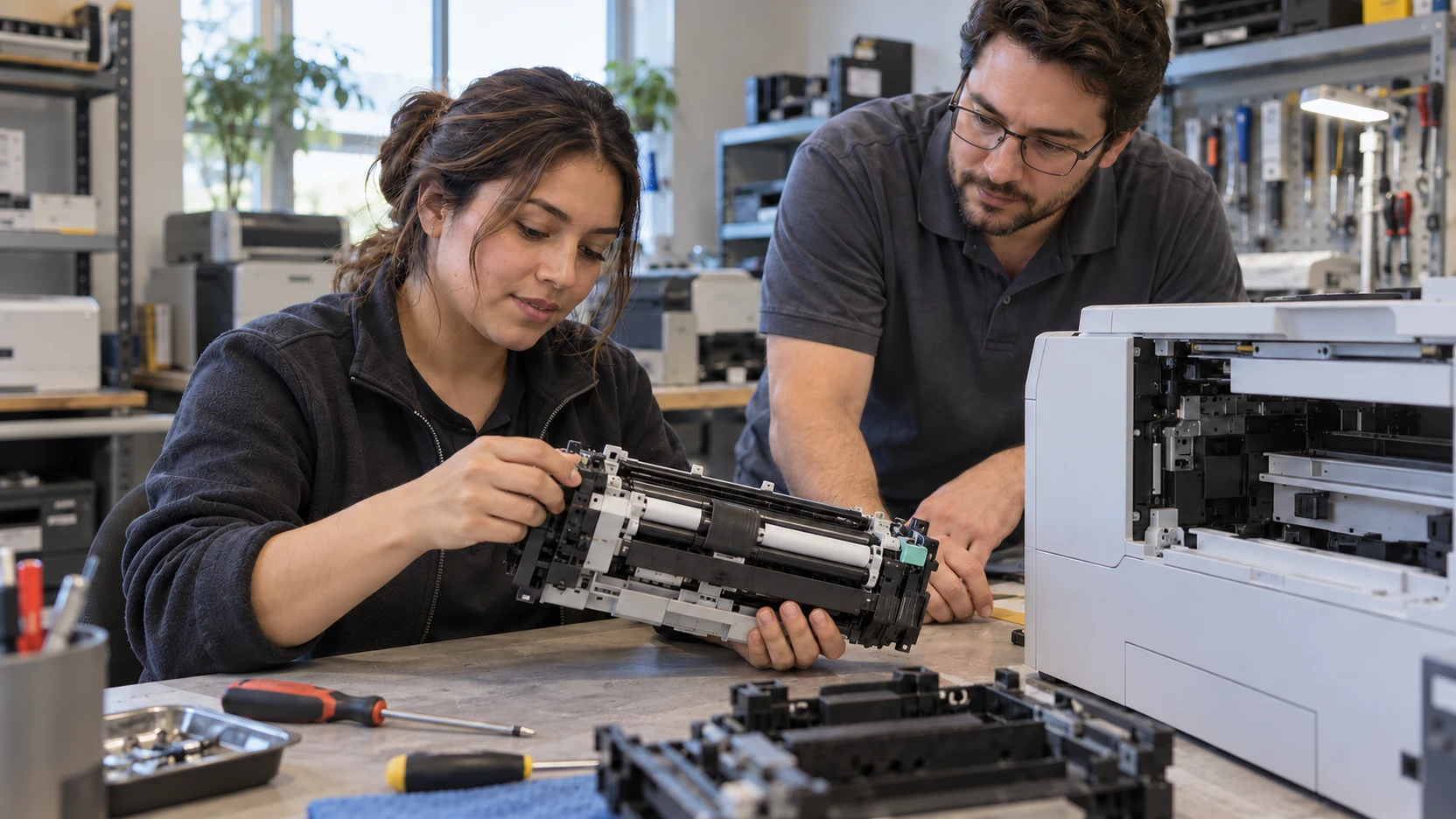
Computer and office equipment repairers repair, maintain, or install computers, word processing systems, automated teller machines, and electronic office machines, such as duplicating and fax machines.
Opening this tab’s Trail…
Fictional preview only. Closing this tab or clearing browser data can remove this work; no account or cloud sync.
What the work involves
O*NET task statements for this occupation.
- Travel to customers' stores or offices to service machines or to provide emergency repair service.
- Reassemble machines after making repairs or replacing parts.
- Advise customers concerning equipment operation, maintenance, or programming.
See 21 more tasks
- Maintain parts inventories and order any additional parts needed for repairs.
- Converse with customers to determine details of equipment problems.
- Disassemble machines to examine parts, such as wires, gears, or bearings for wear or defects, using hand or power tools and measuring devices.
- Maintain records of equipment maintenance work or repairs.
- Repair, adjust, or replace electrical or mechanical components or parts, using hand tools, power tools, or soldering or welding equipment.
- Operate machines to test functioning of parts or mechanisms.
- Assemble machines according to specifications, using hand or power tools and measuring devices.
- Install and configure new equipment, including operating software or peripheral equipment.
- Analyze equipment performance records to assess equipment functioning.
- Reinstall software programs or adjust settings on existing software to fix machine malfunctions.
- Update existing equipment, performing tasks such as installing updated circuit boards or additional memory.
- Test new systems to ensure that they are in working order.
- Test components or circuits of faulty equipment to locate defects, using oscilloscopes, signal generators, ammeters, voltmeters, or special diagnostic software programs.
- Clean, oil, or adjust mechanical parts to maintain machines' operating efficiency and to prevent breakdowns.
- Complete repair bills, shop records, time cards, or expense reports.
- Read specifications, such as blueprints, charts, or schematics, to determine machine settings or adjustments.
- Align, adjust, or calibrate equipment according to specifications.
- Fill machines with toners, inks, or other duplicating fluids.
- Lay cable and hook up electrical connections between machines, power sources, and phone lines.
- Train new repairers.
- Enter information into computers to copy programs from one electronic component to another or to draw, modify, or store schematics.
A question about this career
Which part of this work would you like to see in person? Save this career to your Trail and keep the question beside it.
Open my TrailSkills, knowledge and working conditions
Skills used
- Active Listening
- Critical Thinking
- Speaking
- Reading Comprehension
- Repairing
- Complex Problem Solving
- Troubleshooting
- Equipment Selection
Knowledge that helps
- Computers and Electronics
- Customer and Personal Service
- Mechanical
- English Language
- Engineering and Technology
- Communications and Media
- Time sitting
- Never · 40% selected this answer
- Outside in the weather
- Never · 62% selected this answer
- In-person discussions
- Every day · 76% selected this answer
- Time standing
- Continually or almost continually · 40% selected this answer
Education and training
- Typical entry education
- Some college, no degree
- BLS figure for this job
- Overall preparation
- Job Zone 1–2
- Job Zone 1-2: Very Little to Some Preparation Needed
Training and experience
Usually requires a high school diploma or GED, though some occupations may not.
Short-term on-the-job training
Pay and employment
Median annual pay
$47,810
8 in 10 earn $35,910–$71,730 · May 2025 · BLS figure for this job
National job outlook
2025–35 · BLS figure for this job
Compare states on the map
Where people work
May 2025 · BLS state estimates
Hover to preview; select a state to keep its details. Zoom and scroll for a closer look, or use the state menu. On the map, arrow keys move through states alphabetically. Enter or Space selects a state.
These are jobs people already hold, not vacancies. Self-employed workers are not included.
About these figures and the map
Shading compares states with published estimates for Computer, Automated Teller, and Office Machine Repairers. Concentration means jobs in this occupation per 1,000 employed people in a state. Total jobs means estimated employment, not openings. The figures exclude self-employed workers. Striped gray states have no published estimate for the selected measure; that does not mean no one works there.
Boundaries: US Atlas / US Census. Larger states occupy more map area; their size does not indicate more jobs.
Occupation interest pattern
Interest pattern
What this work leans on
Career ratings are out of 7. Your completed quiz totals are out of 50. These are different scales; the overall pattern matters, not equal bar lengths or ability.
- Building (Realistic)5.8Career rating 5.8 of 7. No personal quiz comparison.
- Organizing (Conventional)5.5Career rating 5.5 of 7. No personal quiz comparison.
- Investigating (Investigative)2.6Career rating 2.6 of 7. No personal quiz comparison.
- Leading (Enterprising)1.8Career rating 1.8 of 7. No personal quiz comparison.
- Helping (Social)1.8Career rating 1.8 of 7. No personal quiz comparison.
- Creating (Artistic)1.0Career rating 1.0 of 7. No personal quiz comparison.
More specific themes
- Information Technology
- Engineering
- Mechanics/Electronics
Related careers to explore
- Industrial Electronics Repairers
- Calibration Technicians
- Telecommunications Equipment Technicians
- Electrical and Electronics Engineering Technicians
- Vending and Amusement Machine Technicians
- Electromechanical Assemblers
- Computer Support Specialists
- Robotics Technicians
- Transportation Electronics Technicians
- Industrial Machinery Mechanics
- Medical Equipment Repairers
- Vehicle Electronics Installers and Repairers
- Audiovisual Equipment Technicians
- Camera Equipment Repairers
- Avionics Technicians
- CNC Machine Operators
- Mechatronics and Electromechanical Technicians
- Electronics Engineers
- Aerospace Engineering Technicians
Take a closer look
Investigate one question.
Choose something you still want to understand. Start with the information on this page, or look for a person describing their work.
- What does someone in this job spend time doing?
- What is challenging about the work, and how do they handle it?
- What changes when this job is done in a different workplace?
Find and check an example
This link searches Google in a new tab. Results have not been selected or checked by Kairos. Use your school’s browsing guidance; searching is optional.
The search uses this career’s public title, never your answers or notes.
- Check who made it, when it was made, and which job and workplace it describes.
- Look for a specific example that helps answer your question. A personal story describes one experience, not every job.
- Compare it with this page or a second source. Keep track of what is still uncertain.
For a closer comparison, explain why two people in the same occupation might describe different days.
If you want to return to this career, use “Save to my trail” above. In Trail, write a reason it interests you or a question to follow up.
Open my trail