
Transportation Security Screeners
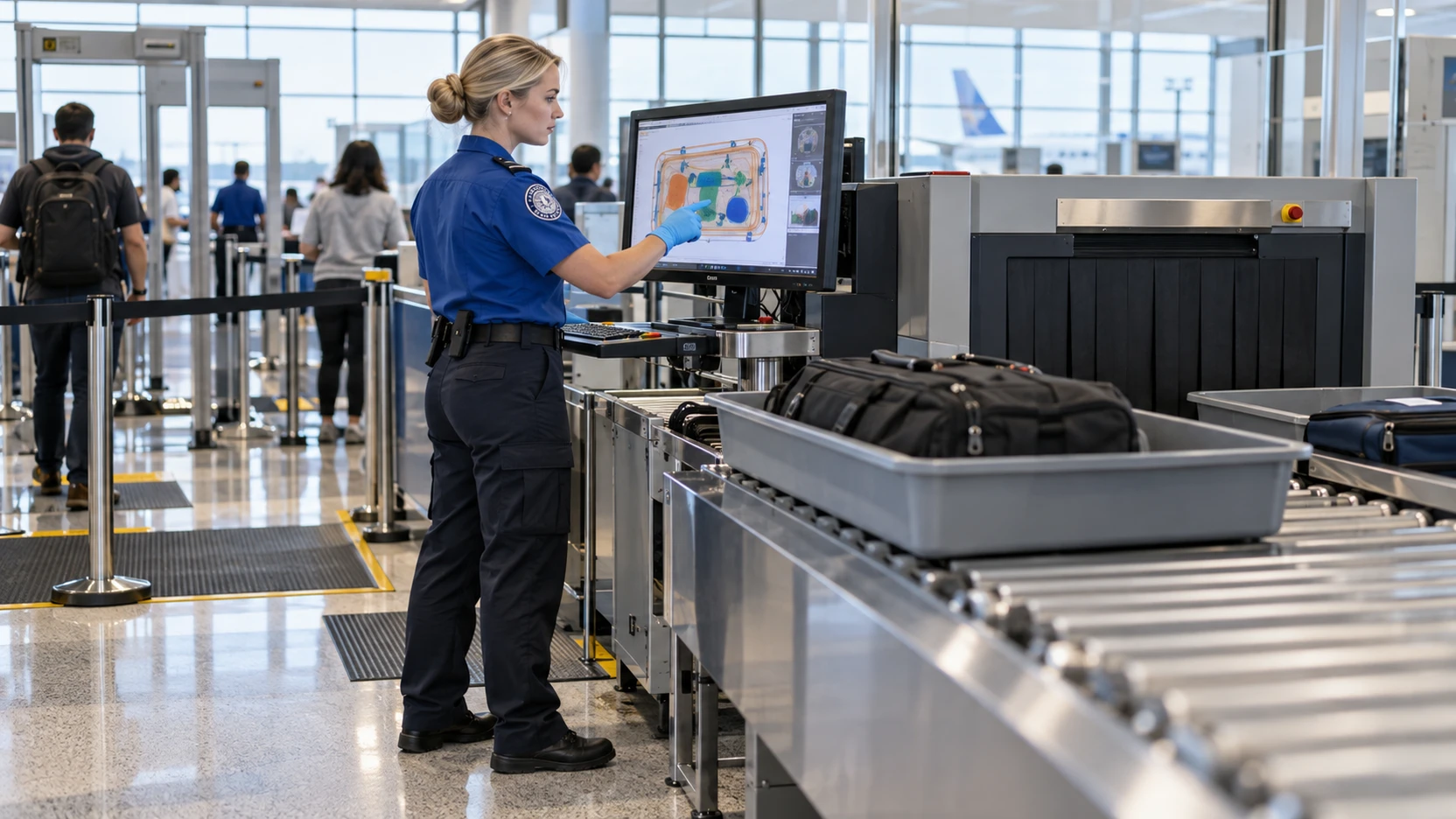
Transportation security screeners conduct screening of passengers, baggage, or cargo to ensure compliance with Transportation Security Administration (TSA) regulations.
Opening this tab’s Trail…
Fictional preview only. Closing this tab or clearing browser data can remove this work; no account or cloud sync.
What the work involves
O*NET task statements for this occupation.
- Inspect carry-on items, using x-ray viewing equipment, to determine whether items contain objects that warrant further investigation.
- Search carry-on or checked baggage by hand when it is suspected to contain prohibited items such as weapons.
- Check passengers' tickets to ensure that they are valid, and to determine whether passengers have designations that require special handling, such as providing photo identification.
See 21 more tasks
- Test baggage for any explosive materials, using equipment such as explosive detection machines or chemical swab systems.
- Perform pat-down or hand-held wand searches of passengers who have triggered machine alarms, who are unable to pass through metal detectors, or who have been randomly identified for such searches.
- Notify supervisors or other appropriate personnel when security breaches occur.
- Send checked baggage through automated screening machines, and set bags aside for searching or rescreening as indicated by equipment.
- Decide whether baggage that triggers alarms should be searched or should be allowed to pass through.
- Follow those who breach security until police or other security personnel arrive to apprehend them.
- Inform other screeners when baggage should not be opened because it might contain explosives.
- Inspect checked baggage for signs of tampering.
- Ask passengers to remove shoes and divest themselves of metal objects prior to walking through metal detectors.
- Close entry areas following security breaches or reopen areas after receiving notification that the airport is secure.
- Challenge suspicious people, requesting their badges and asking what their business is in a particular areas.
- Patrol work areas to detect any suspicious items.
- Contact police directly in cases of urgent security issues, using phones or two-way radios.
- Record information about any baggage that sets off alarms in monitoring equipment.
- Watch for potentially dangerous persons whose pictures are posted at checkpoints.
- Contact leads or supervisors to discuss objects of concern that are not on prohibited object lists.
- Confiscate dangerous items and hazardous materials found in opened bags and turn them over to airlines for disposal.
- Monitor passenger flow through screening checkpoints to ensure order and efficiency.
- Inform passengers of how to mail prohibited items to themselves, or confiscate these items.
- Provide directions and respond to passenger inquiries.
- Direct passengers to areas where they can pick up their baggage after screening is complete.
A question about this career
Which part of this work would you like to see in person? Save this career to your Trail and keep the question beside it.
Open my TrailSkills, knowledge and working conditions
Skills used
- Speaking
- Monitoring
- Active Listening
- Critical Thinking
- Social Perceptiveness
- Coordination
- Judgment and Decision Making
- Persuasion
Knowledge that helps
- Public Safety and Security
- Customer and Personal Service
- English Language
- Law and Government
- Education and Training
- Administration and Management
- People contact
- Constant contact with others · 77% selected this answer
- Time sitting
- Less than half the time · 67% selected this answer
- Outside in the weather
- Never · 59% selected this answer
- Teamwork
- Extremely important · 69% selected this answer
Education and training
- Typical entry education
- High school diploma or equivalent
- BLS figure for this job
- Overall preparation
- Job Zone 1–2
- Job Zone 1-2: Very Little to Some Preparation Needed
Training and experience
Usually requires a high school diploma or GED, though some occupations may not.
Short-term on-the-job training
Pay and employment
Median annual pay
$66,770
8 in 10 earn $44,700–$78,350 · May 2025 · BLS figure for this job
National job outlook
2025–35 · BLS figure for this job
Compare states on the map
Where people work
May 2025 · BLS state estimates
Hover to preview; select a state to keep its details. Zoom and scroll for a closer look, or use the state menu. On the map, arrow keys move through states alphabetically. Enter or Space selects a state.
These are jobs people already hold, not vacancies. Self-employed workers are not included.
About these figures and the map
Shading compares states with published estimates for Transportation Security Screeners. Concentration means jobs in this occupation per 1,000 employed people in a state. Total jobs means estimated employment, not openings. The figures exclude self-employed workers. Striped gray states have no published estimate for the selected measure; that does not mean no one works there.
Boundaries: US Atlas / US Census. Larger states occupy more map area; their size does not indicate more jobs.
Occupation interest pattern
Interest pattern
What this work leans on
Career ratings are out of 7. Your completed quiz totals are out of 50. These are different scales; the overall pattern matters, not equal bar lengths or ability.
- Organizing (Conventional)5.5Career rating 5.5 of 7. No personal quiz comparison.
- Building (Realistic)5.2Career rating 5.2 of 7. No personal quiz comparison.
- Leading (Enterprising)2.6Career rating 2.6 of 7. No personal quiz comparison.
- Helping (Social)2.5Career rating 2.5 of 7. No personal quiz comparison.
- Investigating (Investigative)2.0Career rating 2.0 of 7. No personal quiz comparison.
- Creating (Artistic)1.0Career rating 1.0 of 7. No personal quiz comparison.
More specific themes
- Physical/Manual Labor
- Protective Service
Related careers to explore
- Security Guards
- Flight Attendants
- Airfield Operations Specialists
- Security Supervisors
- Travel Reservations and Ticket Agents
- Customs and Border Protection Officers
- Aircraft Cargo Supervisors
- Compliance Officers
- Security Managers
- Passenger Attendants
- Service and Transportation Dispatchers
- Transit and Intercity Bus Drivers
- Security Planning Specialists
- Train Conductors and Yardmasters
- Air Traffic Controllers
- Subway and Streetcar Operators
Take a closer look
Investigate one question.
Choose something you still want to understand. Start with the information on this page, or look for a person describing their work.
- What does someone in this job spend time doing?
- What is challenging about the work, and how do they handle it?
- What changes when this job is done in a different workplace?
Find and check an example
This link searches Google in a new tab. Results have not been selected or checked by Kairos. Use your school’s browsing guidance; searching is optional.
The search uses this career’s public title, never your answers or notes.
- Check who made it, when it was made, and which job and workplace it describes.
- Look for a specific example that helps answer your question. A personal story describes one experience, not every job.
- Compare it with this page or a second source. Keep track of what is still uncertain.
For a closer comparison, explain why two people in the same occupation might describe different days.
If you want to return to this career, use “Save to my trail” above. In Trail, write a reason it interests you or a question to follow up.
Open my trail