
Correctional Officers
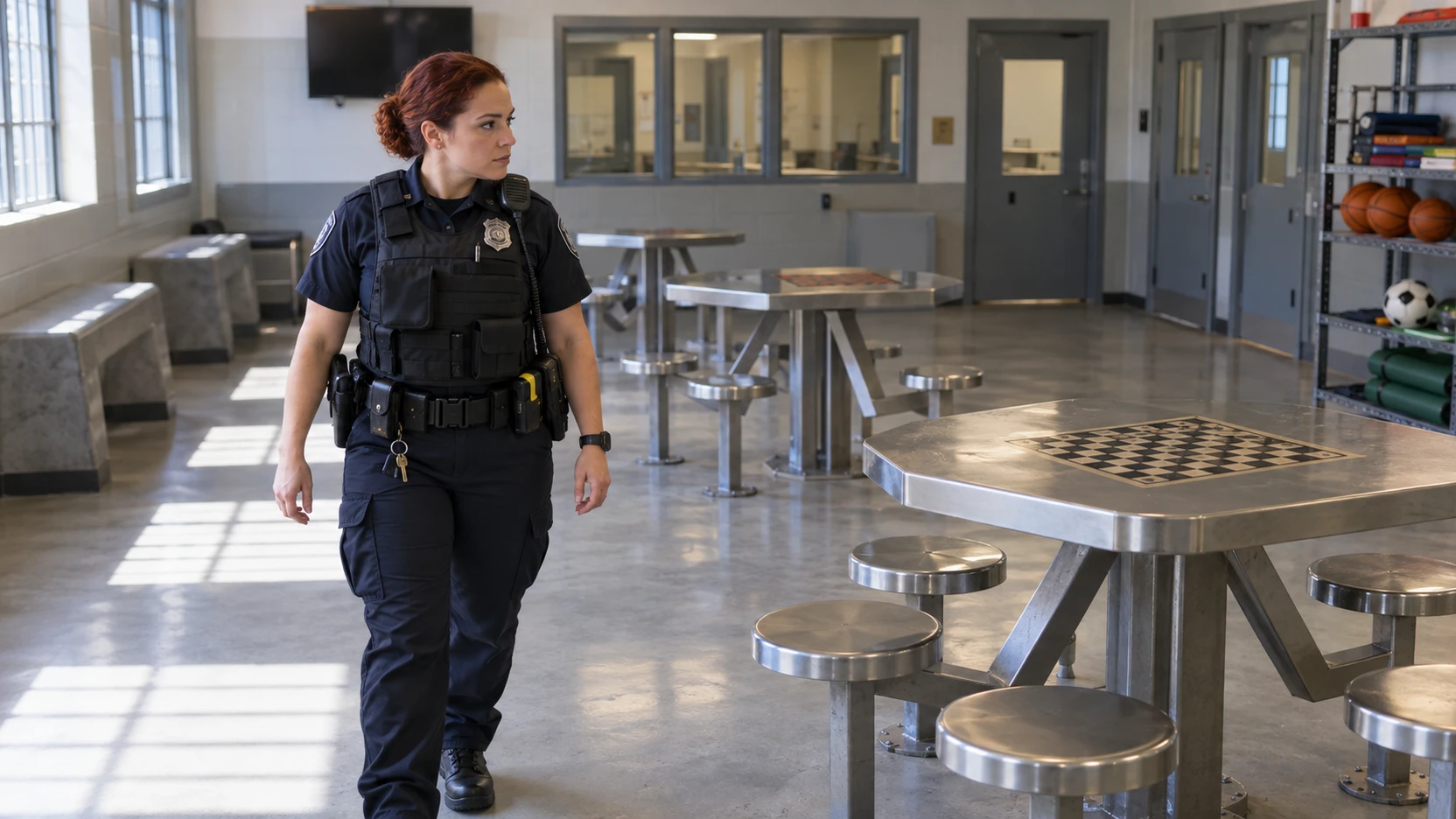
Correctional officers guard inmates in penal or rehabilitative institutions in accordance with established regulations and procedures.
Opening this tab’s Trail…
Fictional preview only. Closing this tab or clearing browser data can remove this work; no account or cloud sync.
What the work involves
O*NET task statements for this occupation.
- Conduct head counts to ensure that each prisoner is present.
- Inspect conditions of locks, window bars, grills, doors, and gates at correctional facilities to ensure security and help prevent escapes.
- Monitor conduct of prisoners in housing unit, or during work or recreational activities, according to established policies, regulations, and procedures, to prevent escape or violence.
See 18 more tasks
- Search prisoners and vehicles and conduct shakedowns of cells for valuables and contraband, such as weapons or drugs.
- Guard facility entrances to screen visitors.
- Record information, such as prisoner identification, charges, and incidents of inmate disturbance, keeping daily logs of prisoner activities.
- Inspect mail for the presence of contraband.
- Maintain records of prisoners' identification and charges.
- Use weapons, handcuffs, and physical force to maintain discipline and order among prisoners.
- Use nondisciplinary tools and equipment, such as a computer.
- Conduct fire, safety, and sanitation inspections.
- Take prisoners into custody and escort to locations within and outside of facility, such as visiting room, courtroom, or airport.
- Participate in required job training.
- Serve meals, distribute commissary items, and dispense prescribed medication to prisoners.
- Settle disputes between inmates.
- Provide to supervisors oral and written reports of the quality and quantity of work performed by inmates, inmate disturbances and rule violations, and unusual occurrences.
- Drive passenger vehicles and trucks used to transport inmates to other institutions, courtrooms, hospitals, and work sites.
- Counsel inmates and respond to legitimate questions, concerns, and requests.
- Assign duties to inmates, providing instructions as needed.
- Issue clothing, tools, and other authorized items to inmates.
- Arrange daily schedules for prisoners, including library visits, work assignments, family visits, and counseling appointments.
A question about this career
Which part of this work would you like to see in person? Save this career to your Trail and keep the question beside it.
Open my TrailSkills, knowledge and working conditions
Skills used
- Active Listening
- Monitoring
- Speaking
- Critical Thinking
- Social Perceptiveness
- Coordination
- Persuasion
- Negotiation
Knowledge that helps
- Public Safety and Security
- English Language
- Law and Government
- Customer and Personal Service
- Administration and Management
- Computers and Electronics
- People contact
- Constant contact with others · 87% selected this answer
- Time sitting
- About half the time · 38% selected this answer
- Outside in the weather
- Never · 32% selected this answer
- Teamwork
- Extremely important · 74% selected this answer
Education and training
- Typical entry education
- High school diploma or equivalent
- BLS figure for this job
- Overall preparation
- Job Zone 1–2
- Job Zone 1-2: Very Little to Some Preparation Needed
Training and experience
Usually requires a high school diploma or GED, though some occupations may not.
Moderate-term on-the-job training
Pay and employment
Median annual pay
$58,940
8 in 10 earn $42,760–$93,220 · May 2025 · BLS figure for this job
National job outlook
2025–35 · BLS figure for this job
Compare states on the map
Where people work
May 2025 · BLS state estimates
Hover to preview; select a state to keep its details. Zoom and scroll for a closer look, or use the state menu. On the map, arrow keys move through states alphabetically. Enter or Space selects a state.
These are jobs people already hold, not vacancies. Self-employed workers are not included.
About these figures and the map
Shading compares states with published estimates for Correctional Officers and Jailers. Concentration means jobs in this occupation per 1,000 employed people in a state. Total jobs means estimated employment, not openings. The figures exclude self-employed workers. Striped gray states have no published estimate for the selected measure; that does not mean no one works there.
Boundaries: US Atlas / US Census. Larger states occupy more map area; their size does not indicate more jobs.
Occupation interest pattern
Interest pattern
What this work leans on
Career ratings are out of 7. Your completed quiz totals are out of 50. These are different scales; the overall pattern matters, not equal bar lengths or ability.
- Building (Realistic)5.3Career rating 5.3 of 7. No personal quiz comparison.
- Organizing (Conventional)4.8Career rating 4.8 of 7. No personal quiz comparison.
- Helping (Social)3.9Career rating 3.9 of 7. No personal quiz comparison.
- Leading (Enterprising)3.2Career rating 3.2 of 7. No personal quiz comparison.
- Investigating (Investigative)1.7Career rating 1.7 of 7. No personal quiz comparison.
- Creating (Artistic)1.1Career rating 1.1 of 7. No personal quiz comparison.
More specific themes
- Law
- Protective Service
Related careers to explore
- Correctional Supervisors
- Probation and Correctional Treatment Specialists
- Police Officers
- Bailiffs
- Police Supervisors
- Detectives and Criminal Investigators
- Security Supervisors
- Security Guards
- Residential Advisors
- Child, Family, and School Social Workers
- Community Service Managers
- College Criminal Justice Teachers
- Private Investigators
- Rehabilitation Counselors
- Court and Government Records Clerks
- Coroners
- Healthcare Managers
- Fire Service Supervisors
Take a closer look
Investigate one question.
Choose something you still want to understand. Start with the information on this page, or look for a person describing their work.
- What does someone in this job spend time doing?
- What is challenging about the work, and how do they handle it?
- What changes when this job is done in a different workplace?
Find and check an example
This link searches Google in a new tab. Results have not been selected or checked by Kairos. Use your school’s browsing guidance; searching is optional.
The search uses this career’s public title, never your answers or notes.
- Check who made it, when it was made, and which job and workplace it describes.
- Look for a specific example that helps answer your question. A personal story describes one experience, not every job.
- Compare it with this page or a second source. Keep track of what is still uncertain.
For a closer comparison, explain why two people in the same occupation might describe different days.
If you want to return to this career, use “Save to my trail” above. In Trail, write a reason it interests you or a question to follow up.
Open my trail