
Brain and Nerve Testing Technologists
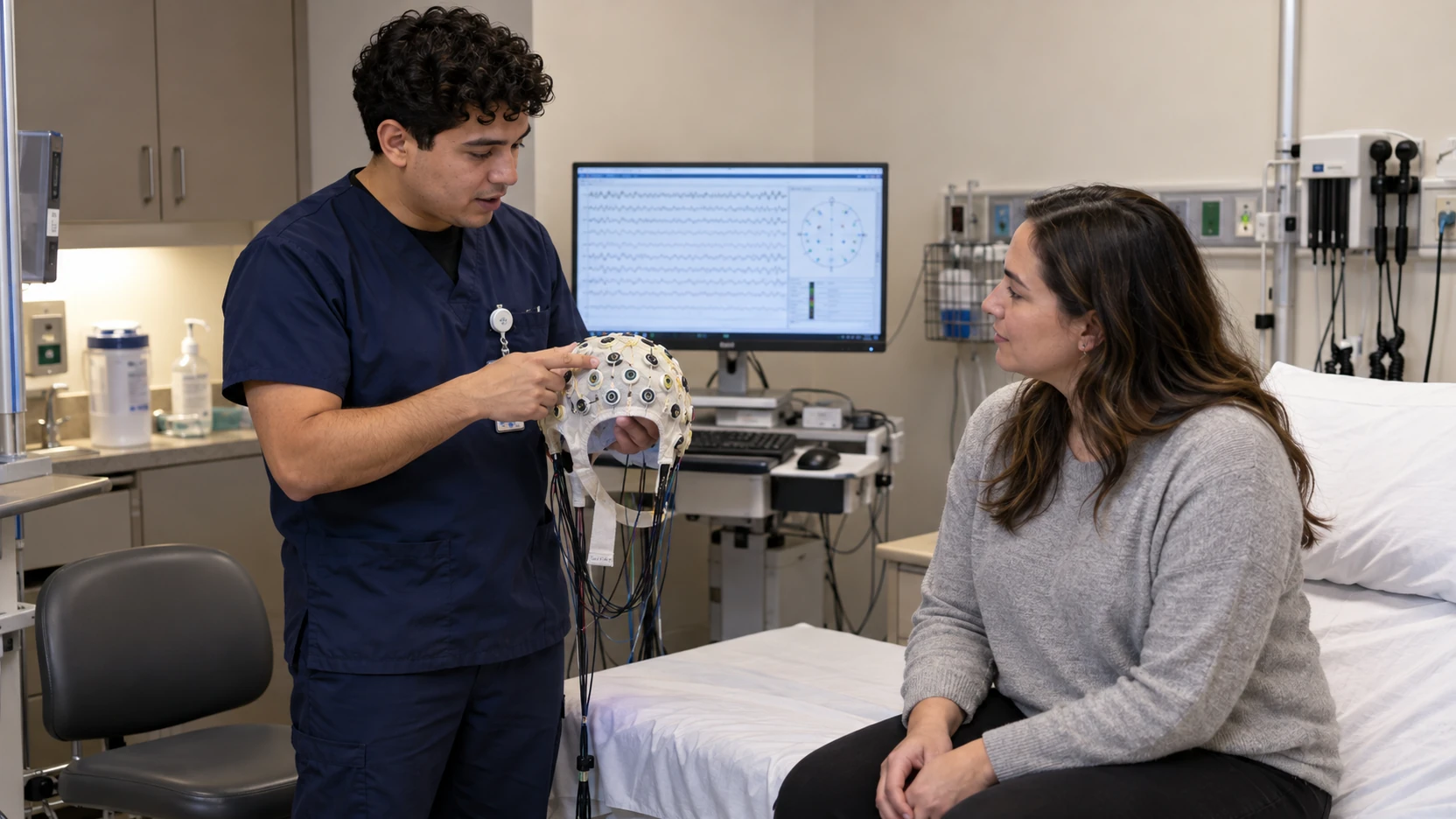
Brain and nerve testing technologists conduct electroneurodiagnostic (END) tests such as electroencephalograms, evoked potentials, polysomnograms, or electronystagmograms.
Opening this tab’s Trail…
Fictional preview only. Closing this tab or clearing browser data can remove this work; no account or cloud sync.
What the work involves
O*NET task statements for this occupation.
- Indicate artifacts or interferences derived from sources outside of the brain, such as poor electrode contact or patient movement, on electroneurodiagnostic recordings.
- Monitor patients during tests or surgeries, using electroencephalographs (EEG), evoked potential (EP) instruments, or video recording equipment.
- Conduct tests or studies such as electroencephalography (EEG), polysomnography (PSG), nerve conduction studies (NCS), electromyography (EMG), and intraoperative monitoring (IOM).
See 13 more tasks
- Collect patients' medical information needed to customize tests.
- Explain testing procedures to patients, answering questions or reassuring patients, as needed.
- Set up, program, or record montages or electrical combinations when testing peripheral nerve, spinal cord, subcortical, or cortical responses.
- Summarize technical data to assist physicians to diagnose brain, sleep, or nervous system disorders.
- Conduct tests to determine cerebral death, the absence of brain activity, or the probability of recovery from a coma.
- Attach electrodes to patients, using adhesives.
- Measure patients' body parts and mark locations where electrodes are to be placed.
- Submit reports to physicians summarizing test results.
- Calibrate, troubleshoot, or repair equipment and correct malfunctions, as needed.
- Adjust equipment to optimize viewing of the nervous system.
- Measure visual, auditory, or somatosensory evoked potentials (EPs) to determine responses to stimuli.
- Assist in training technicians, medical students, residents, or other staff members.
- Participate in research projects, conferences, or technical meetings.
A question about this career
Which part of this work would you like to see in person? Save this career to your Trail and keep the question beside it.
Open my TrailSkills, knowledge and working conditions
Skills used
- Active Listening
- Speaking
- Reading Comprehension
- Critical Thinking
- Social Perceptiveness
- Instructing
- Service Orientation
- Complex Problem Solving
Knowledge that helps
- English Language
- Customer and Personal Service
- Computers and Electronics
- Medicine and Dentistry
- Biology
- Psychology
- People contact
- Constant contact with others · 71% selected this answer
- Time sitting
- More than half the time · 47% selected this answer
- Outside in the weather
- Never · 100% selected this answer
- Teamwork
- Extremely important · 61% selected this answer
Education and training
- Typical entry education
- Postsecondary nondegree award
- BLS group: Health technologists and technicians, all other
- Overall preparation
- Job Zone 3
- Job Zone Three: Medium Preparation Needed
Training and experience
Most occupations in this zone require training in vocational schools, related on-the-job experience, or an associate's degree.
None
Pay and employment
Median annual pay
$50,290
8 in 10 earn $38,180–$85,270 · May 2025 · BLS group: Health technologists and technicians, all other
National job outlook
2025–35 · BLS group: Health technologists and technicians, all other
Compare states on the map
Where people work
May 2025 · BLS state estimates
Hover to preview; select a state to keep its details. Zoom and scroll for a closer look, or use the state menu. On the map, arrow keys move through states alphabetically. Enter or Space selects a state.
These are jobs people already hold, not vacancies. Self-employed workers are not included.
About these figures and the map
Shading compares states with published estimates for Health Technologists and Technicians, All Other. Concentration means jobs in this occupation per 1,000 employed people in a state. Total jobs means estimated employment, not openings. The figures exclude self-employed workers. Striped gray states have no published estimate for the selected measure; that does not mean no one works there.
Boundaries: US Atlas / US Census. Larger states occupy more map area; their size does not indicate more jobs.
Occupation interest pattern
Interest pattern
What this work leans on
Career ratings are out of 7. Your completed quiz totals are out of 50. These are different scales; the overall pattern matters, not equal bar lengths or ability.
- Investigating (Investigative)5.8Career rating 5.8 of 7. No personal quiz comparison.
- Building (Realistic)5.3Career rating 5.3 of 7. No personal quiz comparison.
- Organizing (Conventional)4.5Career rating 4.5 of 7. No personal quiz comparison.
- Helping (Social)3.7Career rating 3.7 of 7. No personal quiz comparison.
- Leading (Enterprising)1.4Career rating 1.4 of 7. No personal quiz comparison.
- Creating (Artistic)1.4Career rating 1.4 of 7. No personal quiz comparison.
More specific themes
- Life Science
- Medical Science
- Health Care Service
Related careers to explore
- Cardiovascular Technologists and Technicians
- Radiology Technologists and Technicians
- Ultrasound Technologists
- Medical Laboratory Technologists
- MRI Technologists
- Radiation Therapists
- Eye-Care Medical Technicians
- Medical Laboratory Technicians
- Nuclear Medicine Technologists
- Cardiologists
- Anesthesiologist Assistants
- Endoscopy Technicians
- Surgical Technologists
- Radiologists
- Respiratory Therapists
- Surgical Assistants
- Anesthesiologists
Take a closer look
Investigate one question.
Choose something you still want to understand. Start with the information on this page, or look for a person describing their work.
- What does someone in this job spend time doing?
- What is challenging about the work, and how do they handle it?
- What changes when this job is done in a different workplace?
Find and check an example
This link searches Google in a new tab. Results have not been selected or checked by Kairos. Use your school’s browsing guidance; searching is optional.
The search uses this career’s public title, never your answers or notes.
- Check who made it, when it was made, and which job and workplace it describes.
- Look for a specific example that helps answer your question. A personal story describes one experience, not every job.
- Compare it with this page or a second source. Keep track of what is still uncertain.
For a closer comparison, explain why two people in the same occupation might describe different days.
If you want to return to this career, use “Save to my trail” above. In Trail, write a reason it interests you or a question to follow up.
Open my trail