
Advanced Practice Psychiatric Nurses
Advanced practice psychiatric nurses assess, diagnose, and treat individuals and families with mental health or substance use disorders or the potential for such disorders.
Opening this tab’s Trail…
Fictional preview only. Closing this tab or clearing browser data can remove this work; no account or cloud sync.
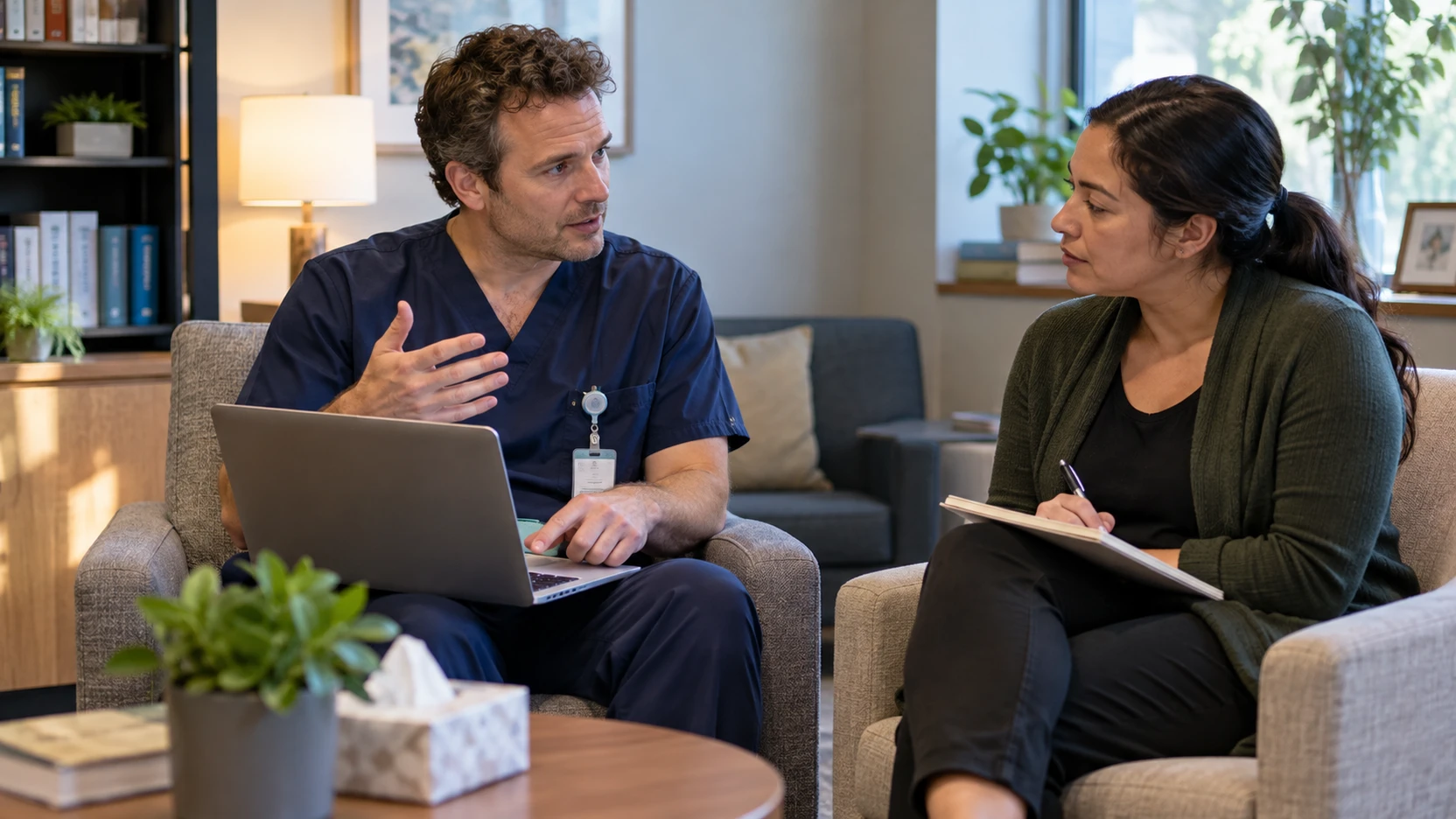
What the work involves
O*NET task statements for this occupation.
- Assess patients' mental and physical status, based on the presenting symptoms and complaints.
- Diagnose psychiatric disorders and mental health conditions.
- Document patients' medical and psychological histories, physical assessment results, diagnoses, treatment plans, prescriptions, or outcomes.
See 17 more tasks
- Educate patients and family members about mental health and medical conditions, preventive health measures, medications, or treatment plans.
- Write prescriptions for psychotropic medications as allowed by state regulations and collaborative practice agreements.
- Monitor patients' medication usage and results.
- Evaluate patients' behavior to formulate diagnoses or assess treatments.
- Distinguish between physiologically- and psychologically-based disorders, and diagnose appropriately.
- Develop and implement treatment plans.
- Conduct individual, group, or family psychotherapy for those with chronic or acute mental disorders.
- Participate in activities aimed at professional growth and development, including conferences or continuing education activities.
- Collaborate with interdisciplinary team members, including psychiatrists, psychologists, or nursing staff, to develop, implement, or evaluate treatment plans.
- Consult with psychiatrists or other professionals when unusual or complex cases are encountered.
- Refer patients requiring more specialized or complex treatment to psychiatrists, primary care physicians, or other medical specialists.
- Participate in treatment team conferences regarding diagnosis or treatment of difficult cases.
- Interpret diagnostic or laboratory tests, such as electrocardiograms (EKGs) and renal functioning tests.
- Develop practice protocols for mental health problems, based on review and evaluation of published research.
- Provide routine physical health screenings to detect or monitor problems such as heart disease and diabetes.
- Administer medications, including those administered by injection.
- Develop, implement, or evaluate programs such as outreach activities, community mental health programs, and crisis situation response activities.
A question about this career
Which part of this work would you like to see in person? Save this career to your Trail and keep the question beside it.
Open my TrailSkills, knowledge and working conditions
Skills used
- Active Listening
- Speaking
- Reading Comprehension
- Writing
- Social Perceptiveness
- Judgment and Decision Making
- Time Management
- Complex Problem Solving
Knowledge that helps
- Psychology
- Therapy and Counseling
- English Language
- Medicine and Dentistry
- Biology
- Sociology and Anthropology
- People contact
- Constant contact with others · 59% selected this answer
- Time sitting
- Continually or almost continually · 70% selected this answer
- Outside in the weather
- Never · 86% selected this answer
- Teamwork
- Very important · 36% selected this answer
Education and training
- Typical entry education
- Bachelor's degree
- BLS group: Registered nurses
- Overall preparation
- Job Zone 5
- Job Zone Five: Extensive Preparation Needed
Training and experience
Most of these occupations require graduate school. For example, they may require a master's degree, and some require a Ph.D., M.D., or J.D. (law degree).
None
Pay and employment
Median annual pay
$97,550
8 in 10 earn $68,940–$137,470 · May 2025 · BLS group: Registered nurses
National job outlook
2025–35 · BLS group: Registered nurses
Compare states on the map
Where people work
May 2025 · BLS state estimates
Hover to preview; select a state to keep its details. Zoom and scroll for a closer look, or use the state menu. On the map, arrow keys move through states alphabetically. Enter or Space selects a state.
These are jobs people already hold, not vacancies. Self-employed workers are not included.
About these figures and the map
Shading compares states with published estimates for Registered Nurses. Concentration means jobs in this occupation per 1,000 employed people in a state. Total jobs means estimated employment, not openings. The figures exclude self-employed workers. Striped gray states have no published estimate for the selected measure; that does not mean no one works there.
Boundaries: US Atlas / US Census. Larger states occupy more map area; their size does not indicate more jobs.
Occupation interest pattern
Interest pattern
What this work leans on
Career ratings are out of 7. Your completed quiz totals are out of 50. These are different scales; the overall pattern matters, not equal bar lengths or ability.
- Helping (Social)6.1Career rating 6.1 of 7. No personal quiz comparison.
- Investigating (Investigative)5.9Career rating 5.9 of 7. No personal quiz comparison.
- Organizing (Conventional)3.4Career rating 3.4 of 7. No personal quiz comparison.
- Creating (Artistic)2.8Career rating 2.8 of 7. No personal quiz comparison.
- Building (Realistic)2.6Career rating 2.6 of 7. No personal quiz comparison.
- Leading (Enterprising)2.0Career rating 2.0 of 7. No personal quiz comparison.
More specific themes
- Medical Science
- Social Science
- Social Service
- Health Care Service
Related careers to explore
- Nurse Practitioners
- Clinical Nurse Specialists
- Psychiatrists
- Psychiatric Technicians
- Family Doctors
- Registered Nurses
- Mental Health Counselors
- Emergency Physicians
- Pediatricians
- Rehabilitation Physicians
- Internal Medicine Doctors
- Neurologists
- Physician Assistants
- Nurse Midwives
- Physical Therapists
- Preventive Medicine Doctors
Take a closer look
Investigate one question.
Choose something you still want to understand. Start with the information on this page, or look for a person describing their work.
- What does someone in this job spend time doing?
- What is challenging about the work, and how do they handle it?
- What changes when this job is done in a different workplace?
Find and check an example
This link searches Google in a new tab. Results have not been selected or checked by Kairos. Use your school’s browsing guidance; searching is optional.
The search uses this career’s public title, never your answers or notes.
- Check who made it, when it was made, and which job and workplace it describes.
- Look for a specific example that helps answer your question. A personal story describes one experience, not every job.
- Compare it with this page or a second source. Keep track of what is still uncertain.
For a closer comparison, explain why two people in the same occupation might describe different days.
If you want to return to this career, use “Save to my trail” above. In Trail, write a reason it interests you or a question to follow up.
Open my trail