
Music Directors and Composers
Music directors lead musical groups during performances and recording sessions. Composers write and arrange music in a variety of musical styles.
Opening this tab’s Trail…
Fictional preview only. Closing this tab or clearing browser data can remove this work; no account or cloud sync.
What the work involves
O*NET task statements for this occupation.
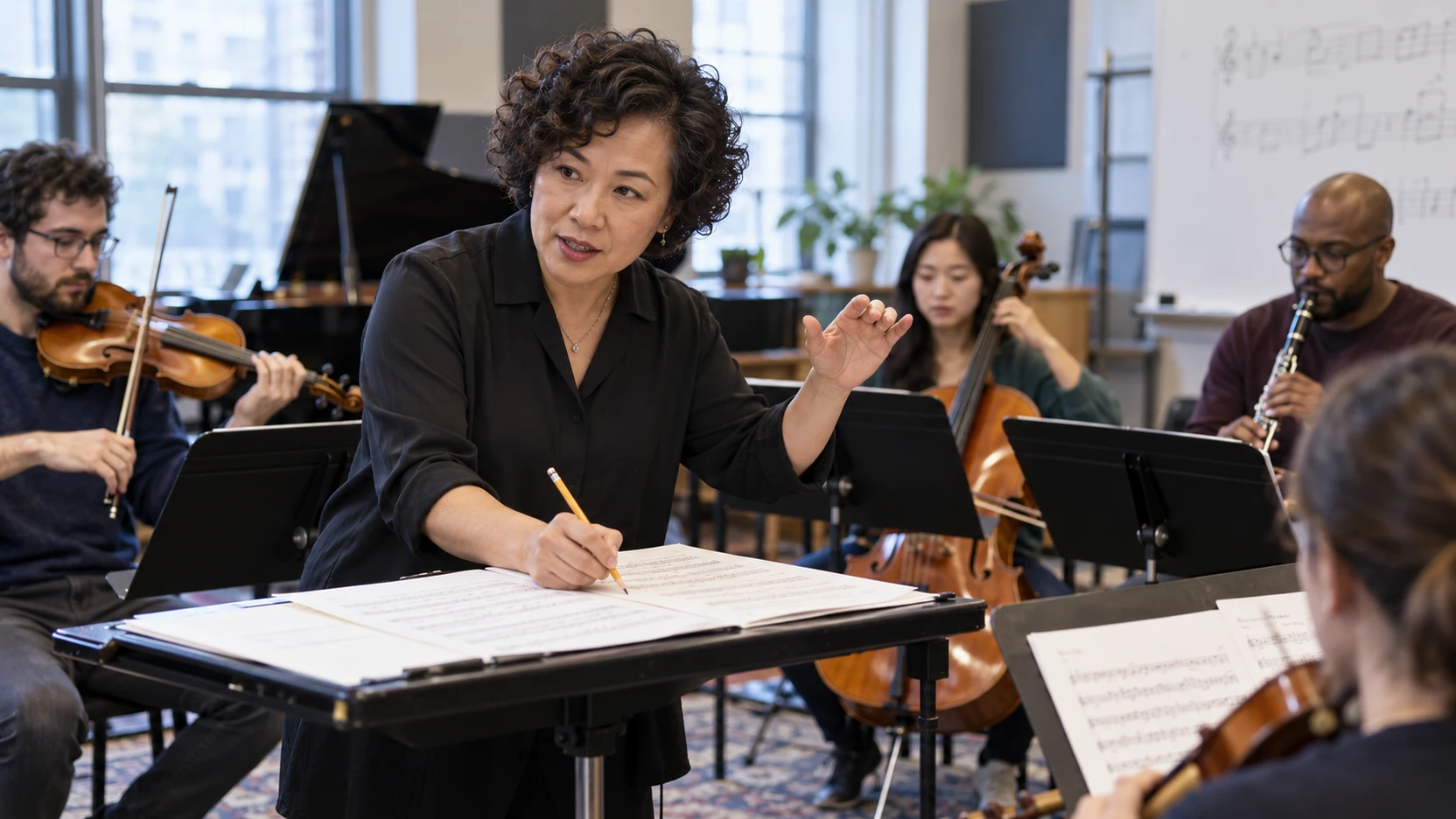
- Use gestures to shape the music being played, communicating desired tempo, phrasing, tone, color, pitch, volume, and other performance aspects.
- Direct groups at rehearsals and live or recorded performances to achieve desired effects such as tonal and harmonic balance dynamics, rhythm, and tempo.
- Study scores to learn the music in detail, and to develop interpretations.
See 21 more tasks
- Apply elements of music theory to create musical and tonal structures, including harmonies and melodies.
- Consider such factors as ensemble size and abilities, availability of scores, and the need for musical variety, to select music to be performed.
- Determine voices, instruments, harmonic structures, rhythms, tempos, and tone balances required to achieve the effects desired in a musical composition.
- Experiment with different sounds, and types and pieces of music, using synthesizers and computers as necessary to test and evaluate ideas.
- Transcribe ideas for musical compositions into musical notation, using instruments, pen and paper, or computers.
- Audition and select performers for musical presentations.
- Plan and schedule rehearsals and performances, and arrange details such as locations, accompanists, and instrumentalists.
- Write musical scores for orchestras, bands, choral groups, or individual instrumentalists or vocalists, using knowledge of music theory and of instrumental and vocal capabilities.
- Position members within groups to obtain balance among instrumental or vocal sections.
- Perform administrative tasks such as applying for grants, developing budgets, negotiating contracts, and designing and printing programs and other promotional materials.
- Confer with producers and directors to define the nature and placement of film or television music.
- Meet with soloists and concertmasters to discuss and prepare for performances.
- Fill in details of orchestral sketches, such as adding vocal parts to scores.
- Explore and develop musical ideas based on sources such as imagination or sounds in the environment.
- Write music for commercial mediums, including advertising jingles or film soundtracks.
- Transpose music from one voice or instrument to another to accommodate particular musicians.
- Rewrite original musical scores in different musical styles by changing rhythms, harmonies, or tempos.
- Arrange music composed by others, changing the music to achieve desired effects.
- Assign and review staff work in such areas as scoring, arranging, and copying music, and vocal coaching.
- Study films or scripts to determine how musical scores can be used to create desired effects or moods.
- Transcribe musical compositions and melodic lines to adapt them to a particular group, or to create a particular musical style.
A question about this career
Which part of this work would you like to see in person? Save this career to your Trail and keep the question beside it.
Open my TrailSkills, knowledge and working conditions
Skills used
- Active Listening
- Speaking
- Reading Comprehension
- Critical Thinking
- Judgment and Decision Making
- Coordination
- Persuasion
- Social Perceptiveness
Knowledge that helps
- Fine Arts
- English Language
- Education and Training
- Computers and Electronics
- Customer and Personal Service
- Philosophy and Theology
- People contact
- Constant contact with others · 48% selected this answer
- Time sitting
- About half the time · 32% selected this answer
- Outside in the weather
- Never · 65% selected this answer
- Teamwork
- Extremely important · 54% selected this answer
Education and training
- Typical entry education
- Bachelor's degree
- BLS figure for this job
- Overall preparation
- Job Zone 4
- Job Zone Four: Considerable Preparation Needed
Training and experience
Most of these occupations require a four-year bachelor's degree, but some do not.
None
Less than 5 years
Pay and employment
Median annual pay
$73,710
8 in 10 earn $39,880–$165,760 · May 2025 · BLS figure for this job
National job outlook
2025–35 · BLS figure for this job
Compare states on the map
Where people work
May 2025 · BLS state estimates
Hover to preview; select a state to keep its details. Zoom and scroll for a closer look, or use the state menu. On the map, arrow keys move through states alphabetically. Enter or Space selects a state.
These are jobs people already hold, not vacancies. Self-employed workers are not included.
About these figures and the map
Shading compares states with published estimates for Music Directors and Composers. Concentration means jobs in this occupation per 1,000 employed people in a state. Total jobs means estimated employment, not openings. The figures exclude self-employed workers. Striped gray states have no published estimate for the selected measure; that does not mean no one works there.
Boundaries: US Atlas / US Census. Larger states occupy more map area; their size does not indicate more jobs.
Occupation interest pattern
Interest pattern
What this work leans on
Career ratings are out of 7. Your completed quiz totals are out of 50. These are different scales; the overall pattern matters, not equal bar lengths or ability.
- Creating (Artistic)7.0Career rating 7.0 of 7. No personal quiz comparison.
- Leading (Enterprising)4.8Career rating 4.8 of 7. No personal quiz comparison.
- Helping (Social)3.0Career rating 3.0 of 7. No personal quiz comparison.
- Organizing (Conventional)2.6Career rating 2.6 of 7. No personal quiz comparison.
- Investigating (Investigative)2.3Career rating 2.3 of 7. No personal quiz comparison.
- Building (Realistic)2.1Career rating 2.1 of 7. No personal quiz comparison.
More specific themes
- Management/Administration
- Media
- Public Speaking
- Applied Arts and Design
Related careers to explore
- Musicians and Singers
- Choreographers
- College Art, Drama, and Music Teachers
- Producers and Directors
- Casting Directors
- Music Therapists
- Art Directors
- Media Programming Directors
- Film and Video Editors
- Actors
- Sound Engineering Technicians
- Dancers
- Musical Instrument Repairers and Tuners
- Media Technical Directors
- Religious Education and Activities Directors
- Sports and Entertainment Agents
- Fine Artists
- Writers and Authors
- Broadcast Announcers and Radio DJs
Take a closer look
Investigate one question.
Choose something you still want to understand. Start with the information on this page, or look for a person describing their work.
- What does someone in this job spend time doing?
- What is challenging about the work, and how do they handle it?
- What changes when this job is done in a different workplace?
Find and check an example
This link searches Google in a new tab. Results have not been selected or checked by Kairos. Use your school’s browsing guidance; searching is optional.
The search uses this career’s public title, never your answers or notes.
- Check who made it, when it was made, and which job and workplace it describes.
- Look for a specific example that helps answer your question. A personal story describes one experience, not every job.
- Compare it with this page or a second source. Keep track of what is still uncertain.
For a closer comparison, explain why two people in the same occupation might describe different days.
If you want to return to this career, use “Save to my trail” above. In Trail, write a reason it interests you or a question to follow up.
Open my trail