
Clergy
Clergy conduct religious worship and perform other spiritual functions associated with beliefs and practices of religious faith or denomination.
Opening this tab’s Trail…
Fictional preview only. Closing this tab or clearing browser data can remove this work; no account or cloud sync.
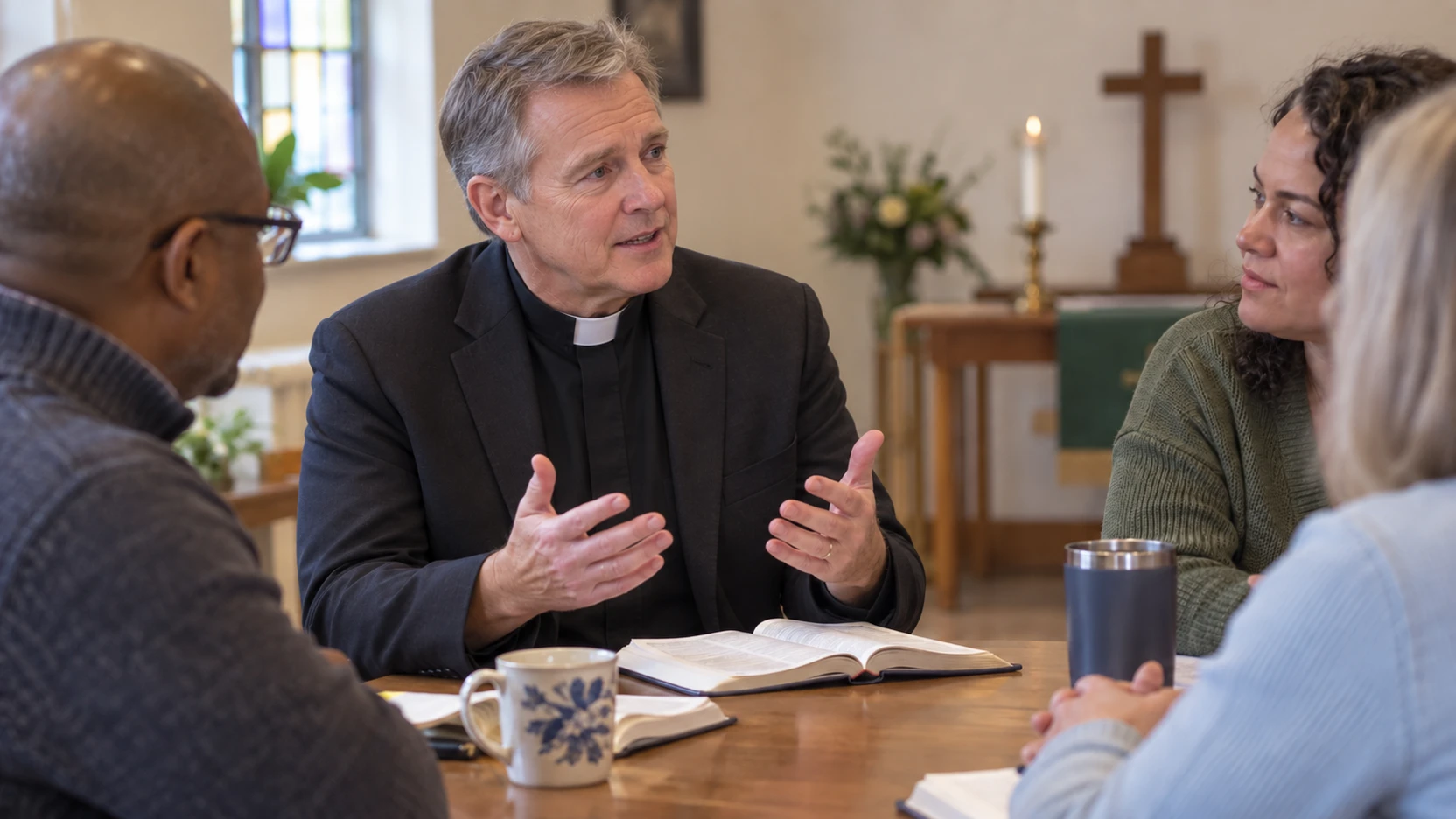
What the work involves
O*NET task statements for this occupation.
- Pray and promote spirituality.
- Prepare and deliver sermons or other talks.
- Read from sacred texts, such as the Bible, Torah, or Koran.
See 18 more tasks
- Organize and lead regular religious services.
- Instruct people who seek conversion to a particular faith.
- Share information about religious issues by writing articles, giving speeches, or teaching.
- Counsel individuals or groups concerning their spiritual, emotional, or personal needs.
- Administer religious rites or ordinances.
- Prepare people for participation in religious ceremonies.
- Visit people in homes, hospitals, or prisons to provide them with comfort and support.
- Train leaders of church, community, or youth groups.
- Plan or lead religious education programs.
- Study and interpret religious laws, doctrines, or traditions.
- Respond to requests for assistance during emergencies or crises.
- Conduct special ceremonies, such as weddings, funerals, or confirmations.
- Devise ways in which congregational membership can be expanded.
- Collaborate with committees or individuals to address financial or administrative issues pertaining to congregations.
- Refer people to community support services, psychologists, or doctors.
- Organize or engage in interfaith, community, civic, educational, or recreational activities sponsored by or related to religious programs.
- Perform administrative duties, such as overseeing building management, ordering supplies, contracting for services or repairs, or supervising the work of staff members or volunteers.
- Participate in fundraising activities to support congregational activities or facilities.
A question about this career
Which part of this work would you like to see in person? Save this career to your Trail and keep the question beside it.
Open my TrailSkills, knowledge and working conditions
Skills used
- Speaking
- Active Listening
- Reading Comprehension
- Writing
- Social Perceptiveness
- Instructing
- Service Orientation
- Persuasion
Knowledge that helps
- Philosophy and Theology
- English Language
- Administration and Management
- Customer and Personal Service
- Education and Training
- Therapy and Counseling
- People contact
- Constant contact with others · 67% selected this answer
- Time sitting
- More than half the time · 51% selected this answer
- Outside in the weather
- Once a year or more but not every month · 53% selected this answer
- In-person discussions
- Every day · 73% selected this answer
Education and training
- Typical entry education
- Bachelor's degree
- BLS figure for this job
- Overall preparation
- Job Zone 5
- Job Zone Five: Extensive Preparation Needed
Training and experience
Most of these occupations require graduate school. For example, they may require a master's degree, and some require a Ph.D., M.D., or J.D. (law degree).
Moderate-term on-the-job training
Pay and employment
Median annual pay
$60,810
8 in 10 earn $37,860–$98,890 · May 2025 · BLS figure for this job
National job outlook
2025–35 · BLS figure for this job
Compare states on the map
Where people work
May 2025 · BLS state estimates
Hover to preview; select a state to keep its details. Zoom and scroll for a closer look, or use the state menu. On the map, arrow keys move through states alphabetically. Enter or Space selects a state.
These are jobs people already hold, not vacancies. Self-employed workers are not included.
About these figures and the map
Shading compares states with published estimates for Clergy. Concentration means jobs in this occupation per 1,000 employed people in a state. Total jobs means estimated employment, not openings. The figures exclude self-employed workers. Striped gray states have no published estimate for the selected measure; that does not mean no one works there.
Boundaries: US Atlas / US Census. Larger states occupy more map area; their size does not indicate more jobs.
Occupation interest pattern
Interest pattern
What this work leans on
Career ratings are out of 7. Your completed quiz totals are out of 50. These are different scales; the overall pattern matters, not equal bar lengths or ability.
- Helping (Social)5.9Career rating 5.9 of 7. No personal quiz comparison.
- Leading (Enterprising)4.2Career rating 4.2 of 7. No personal quiz comparison.
- Creating (Artistic)3.4Career rating 3.4 of 7. No personal quiz comparison.
- Organizing (Conventional)2.9Career rating 2.9 of 7. No personal quiz comparison.
- Investigating (Investigative)2.1Career rating 2.1 of 7. No personal quiz comparison.
- Building (Realistic)2.1Career rating 2.1 of 7. No personal quiz comparison.
More specific themes
- Management/Administration
- Personal Service
- Professional Advising
- Teaching/Education
Related careers to explore
- Religious Education and Activities Directors
- Child, Family, and School Social Workers
- School and Career Counselors
- Human Service Assistants
- Community Service Managers
- College Philosophy and Religion Teachers
- Community Health Workers
- Marriage and Family Therapists
- Healthcare Social Workers
- Mental Health and Addiction Social Workers
- College Administrators
- Residential Advisors
- School Administrators
- College Education Teachers
- Funeral Directors and Arrangers
- Rehabilitation Counselors
- College Social Work Teachers
- Mental Health Counselors
- Health Education Specialists
- Clinical and Counseling Psychologists
Take a closer look
Investigate one question.
Choose something you still want to understand. Start with the information on this page, or look for a person describing their work.
- What does someone in this job spend time doing?
- What is challenging about the work, and how do they handle it?
- What changes when this job is done in a different workplace?
Find and check an example
This link searches Google in a new tab. Results have not been selected or checked by Kairos. Use your school’s browsing guidance; searching is optional.
The search uses this career’s public title, never your answers or notes.
- Check who made it, when it was made, and which job and workplace it describes.
- Look for a specific example that helps answer your question. A personal story describes one experience, not every job.
- Compare it with this page or a second source. Keep track of what is still uncertain.
For a closer comparison, explain why two people in the same occupation might describe different days.
If you want to return to this career, use “Save to my trail” above. In Trail, write a reason it interests you or a question to follow up.
Open my trail